Kip Jones

KIP JONES, an American by birth, has been studying and working in the UK for more than 20 years.
Under the umbrella term of 'arts-led research', his main efforts have involved developing tools
from the arts and humanities for use by social scientists in research and its impact on a wider
public or a Perfomative Social Science.

Jones was Reader in Performative Social Science and Qualitative Research at
Bournemouth University for 15 years.
He is now a Visiting Scholar and and an independent author and scholar.

Kip has produced films and written many articles for academic journals and authored chapters
for books on topics such as masculinity, ageing and rurality, and older LGBT citizens.
Jones' most recent work involves working with Generation Z youth to tell their stories using
social media.
His ground-breaking use of qualitative methods, including Auto-fiction, biography
and auto-ethnography, and the use of tools from the arts in social science research
and dissemination are well-known.

Jones acted as Author and Executive Producer of
the award-winning short film, RUFUS STONE, funded by Research Councils UK.
The film is now available for free viewing on the Internet
and has been viewed by more than 14,000 people in 150 countries.

Areas of expertise
• Close relationships, culture and ethnicity
• Social psychology, sociology
• Ageing, self and identity
• Interpersonal processes, personality,
individual differences,
social networks, prejudice and stereotyping
• Sexuality and sexual orientation
• Creativity and the use of the
arts in Social Science

Media experience
His work has been reported widely
in the media, including:
BBC Radio 4,BBC TV news,Times
Higher Education, Sunday New
York Times, International
Herald-Tribune
and The Independent.

Saturday, 7 January 2012

Tickled pink: the year behind, the year ahead.

-->


"How breakthroughs come, and the price people pay for them". 

It certainly has been a productive and eventful year for me.  After more than five years of scheming, planning, cajoling, compromising and plain hard work, our efforts to produce Rufus Stone the movie culminated with the premiere of the film at Bournemouth University in November.

Bringing this concept of a ‘performative social science’ to fruition in such a major way (£226K of funding by Research Councils UK and three years of research by a dedicated but small team supported by citizen advisors) certainly was a milestone personally.  Working on the film production with director, Josh Appignanesi and Parkville Pictures, along with what to me seemed a huge cast and crew of more than 45 talented individuals for a 30-minute film, was the icing on the cake.  The week of location shoots in rural Dorset and surrounding counties (thank you, SATNAV) in July was truly a personal learning experience I will never forget.  The response that the film received at the premiere was reassuring and heart-warming. 


I can only look to the year ahead with many more screenings of Rufus Stone, both for citizens in rural communities as well as in film festivals and at a few conferences.  It should prove reassuring to all of us for our faith in the project and all of the hard work that went into making it happen.


Something else happened late this year, however, that tickled me pink.


More than ten years ago now, when I was living in a bedsit in Leicester and had just finished my PhD, I decided to write a conference presentation about Ken Gergen and Klaus Riegel.  Both scholars played important roles in the development of my thinking for my thesis.  During this time I came across a volume (Life-span Developmental Psychology Dialectical Perspectives on Experimental Research, edited by Nancy Datan & Hayne W. Reese,published by Academic Press 1977) that was a result of the Fifth West Virginia University Life-Span Developmental Psychology Conference held at Morgantown, West Virginia in 1976. The conference centred on the work of Riegel and the book included a chapter by Gergen.  


My imagination got the best of me.  What if these two, both influences on my own work, had a conversation following that gathering? As I recently explained, reported in a Times Higher Education article, "Gergen is a giant to our generation, so it was good to look back to a time when he was insecure...I wanted to examine how breakthroughs come, and the price people pay for them". Thus, “On a train from Morgantown” was born.


It seems a short time ago now, but we must not forget that in 2001 digital production was limited, at the personal computer level at least.  I found video-cassette recorded footage of trains that would have been in service in West Virginia in 1976 then convinced a techy at my university to help me cut and edit it.  I wrote a script (much like a radio play) and found people to record it on cassette tape (one in Germany, the rest in Leicester).  I produced overhead projections for some of the visuals and created lots of sound files and edited music (again, on cassette) to fill out the imaginary train journey. 


I packed up all these production materials and caught the ferry to Hamburg and then a train to Berlin and a conference at the Free University to present my grand production … to an audience that would include Mary and Ken Gergen.  When my allotted time came, I spent it dashing about starting up a TV, co-ordinating a cassette player, an overhead projector, etc.—a bit like the Wizard of Oz behind his curtain.

Ken Gergen responded quite emotionally following all of this.  The mostly German-speaking audience seemed a bit confused by it all. 


I recall this as a bit of madness on my part at the time, but also in many ways as the public birth of performative social science, or at least the seeds for its future development.  Being a visual person, I wanted to ‘show’ as well as ‘tell’--and this frustration became central to my efforts in developing PSS.


Because publication is/was the end-all of an academic’s life, I began to think about how to possibly publish ‘Morgantown’.  Because of my visual inclinations, I thought that a film script with all of its optical instructions might do the trick.  So I wrote ‘Morgantown’ up as a screenplay, looking at many scripts in order to get a sense of how to present a visual story as text.  A bit of a Pollyanna at publication, I actually submitted the script to a few publications which I naively thought might be adventurous enough to publish it.  They were not and it was rejected.


I put ‘Morgantown’ in a drawer somewhere and so it languished for almost a decade.  About a year ago, the editor of a special issue on the work of Ken Gergen for Springer’s Psychological Studies contacted me and asked if I would be interested in submitting a paper for the issue.  I responded that, yes, I do have something that may be fit for purpose.  Go ahead, I told myself: ‘I dare you.’  I submitted the script for 'Morgantown'.


To my great surprise, the submission was accepted with little change and now is published as a film script in the special issue on Ken Gergen in Psychological Studies.  In my estimation, this represents a great breakthrough for Performative Social Science, or the use of tools from the arts in dissemination of social science research.  It gives others a reference in support of their own work in moving academic publishers to being more open, even inviting, to alternative presentation formats.


Two major events, one year.  Rufus Stone is so important to me personally and a concerted effort of which I am very proud. I am grateful to all involved in making this happen.  The initial resistance of some to its subject matter in fact played a major part in driving me forward and insuring that I did not give up. 


‘Morgantown’ and its eventual acceptance holds a special place for me, however.  In so many ways it represents ‘working in the dark’ against unknown forces and circumstances, but still being driven by our muses to create and invent. 


Morgantown represents what I like to call  ‘kitchen sink’ work—work produced because creativity compels us to find the means, the ways, the materials and then the outlets.  I never want to forget that it is in these personal efforts the potential to make a difference lies.


Some of the responses to the publication of ‘Morgantown’ are repeated below.  They convince me that efforts to open up channels previously closed to innovation and experimentation are not unfounded and offer support and encouragement to others:

-->
·       Congratulations. This is really amazing. Thank you for your courage. And for the work that you are doing for all of us.
·       It’s just wonderful to see the glimpse of barriers breaking down between interdisciplinary research and innovative work. Well done!! It is happening a step at a time and we just need to keep on pushing those boundaries.
·       breaks the waves for academics like me
dreaming of more than the written words
to portray researched life
·       I got very inspired, though, when reading about your publication as I share PSS' engagement and ambition to intensify publications moving in between arts/social sciences/performance …I say/shout "GREAT!!!" from Copenhagen! Thank you for sharing!!
·       I continue to watch your career with great interest and derive much hope for my own work from your example.
·       fantastique!!! gives me hope
·       Think it is really important to share this kind of news as it gives all of us who research in creative ways hope!
·       A massive achievement in the current climate!
·       This is fantastic and I received this just perfect for our course in qualitative research methodologies where I am teaching narrative and performative approaches. Will use your article as a brand new example and hope to encourage some of our students to be more daring!

Monday, 14 November 2011

Rufus Stone

From the programme for Rufus Stone the movie which premièred on 16 November in Bournemouth after more than five years of preparation:

Kip Jones (Executive Producer and Project Lead). Kip Jones was born in a trunk in the Princess Theatre in Pocatella, Idaho. Not really, but that old Judy Garland tune has had its effect on him. As a child, Jones loved finding large cardboard cartons, cutting a hole in them, crawling inside and putting on a show for neighbours and family members. In spite of recent academic achievement and success, he still insists on putting the razzle-dazzle back into scholarly outputs. Theatrical haze is his favourite device.


Harry Kershaw, Josh Appignanesi, Martha Myers-Lowe, Tom Kane at the world premiere of Rufus Stone in Bournemouth, Nov 2011.

 Watch the film here:  https://vimeo.com/109360805

Sunday, 11 September 2011

“No horses were frightened in the making of this motion picture”


Just to be clear: I’m not a wigs and whistles kind of guy.  That is, I have never fancied a day out at a gay pride parade.  All right for some, but for me the idea of being gay, even celebrating it, is not about being ‘outrageous’ in public for an afternoon and then thinking I have won over some disbelievers or bigots.

With my serious mortarboard on: How does such activity open up dialogue, located in human interactions and their social contexts? How does it promote inter-subjectivity, being-together, the encounter and the social construction of meaning? 

Frankly, simply writing about that sort of approach does not seem to me to have changed some attitudes either.

Perhaps making a film with the intent of beginning to change hearts and minds is, ironically, a middle ground: an activity somewhere between ‘Shout it loud; I’m gay and proud!’ and tedious intellectual rhetoric published in unread journal articles. 

Five years ago, I thought I would give it a try, anyway. This is when the scheming for the film, Rufus Stone, began.  Could we, through the use of film, both set to one side typical critical response to academic research and, instead use the outputs of that research to create a place for shared dialogue amongst the very citizens that the research is about?  By sharing stories, could we all warm up a bit around the communal campfire?

The personal irony of taking this ‘road less travelled’ has been that the process has made me somewhat more militant.  Much of my newfound exasperation with ignorance has been ignited by some of the responses to our proposed film, its story and (importantly academically) the findings from the in-depth research in which our script is grounded.

A tendency towards denial continues to astound me. Included in the storyline of Rufus Stone is a prevalence of suicide amongst older gay men, frequently reported in both our biographic interviews and a focus group as well as in the press.  When this is mentioned, a typical response is, “Well, that may be so for their generation, you know, older gays”.  I ask, “Why then is there an international campaign to raise awareness of the increase of suicides amongst gay youth?”  This fact is typically met with silence. (For example: 'Gay Buffalo Teen Commits Suicide ...')

The British do not like to seem to be complaining. Brits often will silently endure a poorly served restaurant meal rather than object to bad service.  Bring up a subject like gay rights, prejudice against gay and lesbian citizens often leading to isolation, even despair and harm amongst many older community members and the British penchant for avoiding awkward conversations goes into overdrive.  The dialogue typically goes something like this:

“I doubt that there are any in our village, anyway.  We hold traditional values in our community”. 

“Well, we don’t care what these folks get up to exactly as long as they don’t do it around here”.

“We have grandchildren.  We need to protect our values for their sake”.

A phrase that is well over one hundred years old now is often repeated in these conversations as a response to calls for understanding and compassion towards gay and lesbian citizens. When a Victorian actor showed too much affection for the leading man, actress, Mrs. Patrick Campbell, replied: ‘My dear, I don't care what they do, so long as they don't do it in the street and frighten the horses’.  The fact that a Victorian attitude frozen in time is today seen as an ‘amusing’ response to an ‘uncomfortable’ conversation simply boggles the mind. ‘Traditional values’ such as tolerance and fair play seem to have no place in this version of community standards. The lark ascending, indeed.

That line, ‘We don’t care what you do as long as you don’t do it in the road and frighten the horses’ is included in the script of Rufus Stone. It is delivered in a speech excusing village attitudes, even making light of a plea for compassion.  In the next scene, the lead character discovers that his boyhood friend has just hung himself.  The point of this juxtapositioning in the storyline is to emphasise that what we say often does have consequences, often, serious ones.

Now for some good news. Between takes of the scene described above, I was waiting with some of the young crew, sheltering ourselves from a sudden shower behind a van packed with leads and sundry cinematic equipment.  The boom operator, Dan, fresh from film school with an unbridled enthusiasm for his role, factiously quizzed me.  “So Kip.  Are horses afraid of gay people?” 

We all laughed. 

“It is less painful to learn in youth than to be ignorant in age”.
 —Proverb

Watch the trailer for RUFUS STONE here,
and catch the filming of the final 'fire scene' here.
Background to the research and film production on RUFUS STONE blog.

 Watch the film here

Saturday, 20 August 2011

A summer holiday, three books and a story

I left New York for Philadelphia on an early morning train and never heard from Jason again.
Group portrait taken at Andy Warhol's Factory (Warhol is fourth left, in the bottom row) New York, New York, March 6, 1968. Pictured are, left to right, bottom row: Johnathan Lieberson, Andreas Brown, Penelope Tree, Andy Warhol, Catherine Milinaire, and Jason Fishbein; second row: Lil Picard, Frances Steloff, Lita Hornick, Al Hansen, Viva, Charles Henri Ford, Kenneth King, and Ruth Ford; third row: Bruce Miller, Buddy Wurthshafter, Ultra Violet, Taylor Mead, Jack Smith, Sally Chamberlain, Wynn Chamberlain, Ron Zimardi, Ken Jacobs, Florence Jacobs, and Maurice Hogenbaum; back row: Bob Cowan, Fred Hughes, Paul Morrissey, Donna Kerness, John Wilcock, and Willoughby Sharp. (Photo by Fred W. McDarrah/Getty Images)

I treasure my solitude but choose a table for ten on my holidays. It encourages me to interact. Even on vacations, I am quite content with my own company. My dining arrangement is always, therefore, full of surprises—for me and certainly for my tablemates.

Getting away from Rufus Stone the movie for a few weeks provided a good percolator for what is next for the film. I also wanted to think about my future, where I would like to be a year from now and what I might be doing then.

Three books helped with this process.

I began with Patti Smith’s Just Kids, a book recommended to me by Mary Gergen. I was soon turned off, however, by Smith’s approach to her own story and her conviction that she was the only child to ever grow up feeling slightly different or alienated. I thought that was what childhood was about. When she referenced Proust in the midst of her tales of preteen angst in New Jersey, I put the book aside and turned to Michael Kimball’s slim volume, Us.

I am a great fan of Kimball’s writing (I refer to his and the work of some of the other writers whom he has interviewed as ‘the new writing’). I often recommend his books to fellow academics as a kind of intellectual colonic irrigation for the scholar’s literary outpourings.

This will not be a review of Kimball’s book, but just to say that it is the first book I have read in a long, long time that, when it ended, I wished it hadn’t. His ability to describe minutia precisely in a conversational tone is astonishing. Kimball is someone at whom Proust would have smiled. He constructs, through simple sentences, complex situations and ideas. He is particularly skilful at describing innermost thoughts and feelings and the meniscus that both separates and joins those two intertwining elements in our lives. I love his writing.

I then turned to a quite silly book about Truman Capote entitled, Party of the Century (that would be the last Century) by Deborah Davis. Perhaps I should explain why I was reading this book before I loose all credibility here. There are definite reasons for my reading it, which can only be explained in my usual tangential style and detail. Please indulge me.

Firstly, I am giving a party next month for the cast and crew of Rufus Stone the movie. I was so impressed by how hard they all worked for little or no money the week of the film shoot that I wanted to thank them personally. As Mildred Pierce said, ‘Let’s get stinko’ and I thought that we should gather again to celebrate.

In 1966 Capote, when not comparing his own talents to Proust’s, was spending months and months planning and plotting his black and white masquerade ball at the Plaza Hotel in New York. The event was to be a celebration for nearly 400 of his ‘closest’ friends to mark the huge success of his book, In Cold Blood, supposedly. It turns out that creating the guest list was just as much of a production of preparation as the party itself. One detail that particularly fascinated me is that he would not permit anyone invited to bring a husband, wife or partner if both parties were not on his guest list. Instead, Capote invited a ‘hundred extra men’ to ‘partner’ lone women guests.

This is where Jason Fishbein comes in.

My story here relates to our story of Rufus Stone in that this simple country boy (me) went to the big city (Philadelphia) way back when (then) and enrolled in art studies (Philadelphia College of Art). Philadelphia has more art students per capita than any other place on the planet.

I met Jason who had graduated from another of the city’s art schools that year, having just completed a year’s sojourn in Europe on a fellowship. He was a star of the student art world and the son of the owners of Philadelphia’s very exclusive (and oldest) jewellery store. He was living at the time in a townhouse with the owner of the city’s trendiest and most popular gay bar where he conveniently had a studio in the atelier. In fact, the first time I ever nervously entered a gay establishment was in the daytime when the bars were closed to help Jason remove some paintings from his studio above the building’s three uninterrupted étages of gaiety.

He was handsome, talented, so sophisticated, slightly older than me and about to embark on a career move to a New York City West Side loft. Oh, and he listened to show music. I was overcome with glee! At that time I was not so sure of my own sexuality, but certain that Jason was attractive. He made overtures to me, but I shyly fended them off, nonetheless continuing to fawn over him at every chance I got. I was dazed and confused, but certainly smitten.

I offered to help him make the move to his New York loft. We packed up a rental van and left for NYC and a real West Side loft situated in an old industrial building with worn wooden floors, lots of windows and little else. The grimness and decay of this particular West Side neighbourhood was never reflected in West Side Story that was for sure. Jason had crammed the van with paintings, a chandelier, bags of clothes, a small refrigerator full of booze (from the bar I assumed) and some mattresses. After the unpacking, drinking and merriment, we (Jason, a young woman who always seemed to be hanging around him, and a male friend of Jason’s from New York who met us at the loft to help) settled down to sleep on mattresses on the loft floor that night. Jason bedded me with this other guy and put himself on the mattress next to the girl because she was feigning fright at her first night in the “big city”. I knew little of the subtleties of social manipulation back then but quickly learned that night.

Without going into detail, I spent the long night on the floor of that loft pushing this stranger off of me. I was very upset that Jason had put me to bed with this unfamiliar person as some sort of loft house-warming gift for his friend instead choosing me for himself. As a reluctant, shy country boy, I reminisce that I would have finally been ready to ‘give in’ to Jason that night, if he had shared his bed with me instead.

With little sleep and cast off in such a cavalier way, I left New York for Philadelphia on an early morning train and never heard from Jason again. I returned to my girlfriend in Philadelphia, turning my back on the complexities of a world that I was yet to understand. My relationship with a woman seemed a simpler solution, except for the ever-increasing awareness of the painful dishonesty of our situation, of which I was becoming more and more conscious. (Who’s invoking Proust now?)

A few months later I opened the newspaper to see a photo of Jason on the front page with the inscription, “Jason Fishbein, artist, whose mask was a sensation at the Capote ball at the Plaza last night”. Jason had “arrived” in New York.

Recently by chance, I came across another photo from 1968 of Andy Warhol and his entourage, taken by top photographer of the 60’s counter-culture, Fred McDarrah. Jason Fishbein is dead centre in this shot. I guess he did okay after his success at the ball as well.

I was really curious about what had happened to him since then and that is why I wanted to read Party of the Century. Jason isn’t mentioned in the book by name, unfortunately, but his having been one of Capote’s “single escorts” now seems conceivable. I assume that in Capote’s Upper East Side world of New York high society, inviting gay males to such an upscale party needed some sort of plausible ‘social justification’ and Capote had come up with this rather bizarre solution.

What is the purpose of this story? Well, I suppose it is to say once more that being gay and stories about being gay are never straight forward (no pun intended) or simple. Our life stories are played out in an entrenched heterosexual culture and society, which often produces not only our angst, insecurities and complexes, but also the variety and richness of alternative lives and lifestyles as solutions for many of us.

No Patti, being a Tomboy is not life’s only young struggle.

Monday, 1 August 2011

Rufus Stone: Reports from locations, Part 2

Rufus Stone: Reports from location, Part 2


Video by Trevor Hearing

About this video:
"A second location report about the set of the film Rufus Stone, directed by Josh Appignanesi. Rufus Stone is a film about love, sexual awakening and treachery, set in the bucolic countryside of south west England, and viewed through the lens of growing older. It is based on knowledge gathered as part of the research project "Gay and Pleasant Land? - a study about positioning, ageing and gay life in rural South West England and Wales." The project has been funded by the UK Research Councils. The research has been led by the film's Executive Producer, Dr Kip Jones."

Saturday, 30 July 2011

Rufus Stone: Reports from location, Part 1


Rufus Stone: Reports from location, Part 1

Video by Trevor Hearing

About this video:
"A location report about the film Rufus Stone, directed by Josh Appignanesi. Rufus Stone is a film about love, sexual awakening and treachery, set in the bucolic countryside of south west England, and viewed through the lens of growing older. It is based on knowledge gathered as part of the research project "Gay and Pleasant Land? - a study about positioning, ageing and gay life in rural South West England and Wales." The project has been funded by the UK Research Councils. The research has been led by the film's Executive Producer, Dr Kip Jones."

Thursday, 28 July 2011

Rufus Stone: nascita/finale

The road from inception of the idea to the making of the film, 'Rufus Stone', has been a long one. This video represents that beginning in scholarship and inspiration and ending in art.

A page from my notebook inscribes the first time I thought of 'Rufus Stone' as the character and the title for the film. Some of the books that I consumed along the journey are included in the shot.

During the shoot of the final scene for the film I remarked how the process of capturing the scene was a small film in itself and began filming on my tiny Canon camera. It reminded me of Fellini, but also of a ballet, the crew and equipment as dancers. Minghella's 'Butterfly' also came to mind and his use of character movement across a static horizonal platform.


'Rufus Stone' the movie goes into post-production shortly. I wanted to capture here, however, the spirit of the making of that film and represent what it meant to me emotionally.

Music: Puccini's "Elegy for String Quartet - Crisantemi"

Follow Rufus Stone the movie on its blog.
 Watch the film here:  https://vimeo.com/109360805

Friday, 1 July 2011

"Once upon a time on the set with John Huston"


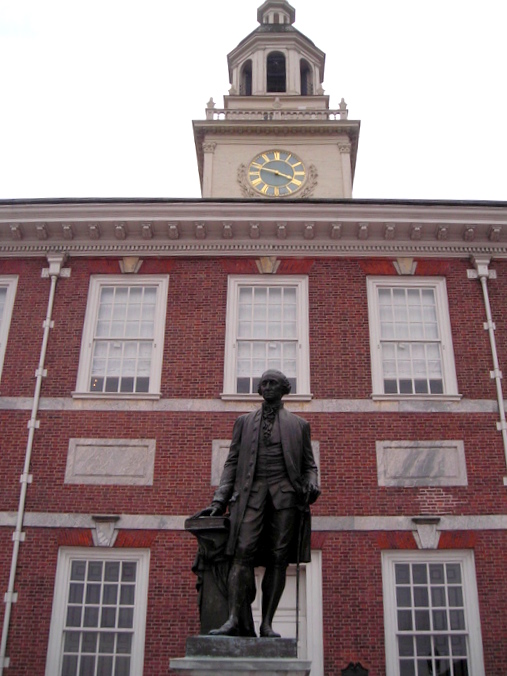
I have dined out for years on my story of being on the set when John Huston directed the short film, Independence, shot in 1976 by 20th Century Fox for the US National Park Service in Philadelphia. The film starred Ken Howard as Thomas Jefferson, Patrick O’Neil as George Washington, Anne Jackson as Abigail Adams and Eli Wallach as Benjamin Franklin.

At the time, I was doing a course in Museum Studies at Independence National Park and the course leader asked if I would like to represent the Museum on the shoot. I guess I was supposed to make sure that none of the priceless historical antiques were damaged. Of course, I agreed, simply to be present during the filming.

We are currently moving through pre-production and into the shoot of our short film, Rufus Stone and this reminds me of that other film in my distant past. In some ways, Huston’s production staff had it easier, because their locations were all within a few city blocks of each other and the furnishings already correct and in place.

We are finding that shooting in rural Dorset and being true to our research on ageing, sexuality and rurality is not as easy. The myth of rural Britain is that it is comprised of restored thatched cottages, stately homes, and an Aga in every kitchen. Missing in the myth is much of the poverty that exists, the isolation, the downturns in and disappearance of ‘village life’, including scarce resources like post offices and even pubs. No one seems to walk in villages anymore; the car is King.

Many of the locations we are finding are former workers’ cottages joined together into one dwelling, their brickwork or whitewashed plaster scrubbed to within an inch of its life, thatch roofs plopped on top, and then the rear roof incline given that 21st Century country house necessity, several skylights. Because part of our film represents the countryside in the 1950s, these dwellings become particularly problematic for us to film. Still, we are getting there, after several weeks of location scouting. The team has come up with some great places that really have the feel of the story. We strongly believe that the locations will tell the tale as much as any dialogue.
Assembly Room, Independence Hall, Philadelphia PA
First sighting: John Huston
The scene: Independence Hall, Philadelphia
Characters: Members of the Continental Congress; men in white hose and wigs abound

Everything was in place to film the scene, the actors near the front of the Hall near the famous desk. Cast and crew were ready, equipment in place, waiting for John Huston to arrive.

The doors opened and in he came, escorted to a period chair set up just behind the camera with one of the Hall’s antique side tables next to it. On it was a Martini shaker, a glass and an ashtray. Huston took a moment to look through the lens of the camera without saying anything. He then sat, took a cigar out of his jacket pocket and lit it, sipped at his Martini and shouted, ‘Action!”

Needless to say, smoking, let alone drinking, was forbidden in Independence Hall. Somehow, Huston must have received a governmental dispensation. Since he had said ‘Action!’ I figured I couldn’t interfere; too late to exercise my lightweight, supposed powers as representative of the Museum, even if I had been brave enough to object.

After a few days, the interior scenes finished and filming moved to exterior shots outside of Carpenter’s Hall, with horses and carriages to manage through the narrow cobble street. There was much use of fog to give the scene a kind of period authenticity. I love a bit of theatrical haze so was quite excited by this effect.

On the next to the last day of the shoot, there was an unscheduled meeting of all cast and crew called for early morning in Independence Hall. We all gathered as requested. Huston made his entrance. This time he went to the front of the Hall and leaned against the table where the Declaration of Independence was signed.

A hush fell over the room as the bright lights placed in the south-facing windows replicating natural daylight were turned on. Huston began by telling the cast and crew that the production had run out of money to finish the film. He then continued his speech, peppering it by mentioning the founding fathers by name, the historical importance of the film and a bit on his love of show business thrown in for good measure. He appealed to cast and crew ‘as Americans’ to work for another day and a half, no more, for no pay. The assemblage applauded his speech at the finish and agreed to work on and film for free until the project was completed.

I am learning my role as Executive Producer of Rufus Stone on the job. I knew from the beginning that a big part of my role would be making sure that the Research Councils’ money is wisely spent. The second part is insuring that our film represents our three years of research on ageing, sexuality and rurality as truthfully as possible.

Turning research into a professional film is a big gamble on my part. I have been convinced of the possibilities of it for some time; now is the time to face the reality of it. One thing I am learning in the process is that small details matter: they can best represent the research ‘findings’, but also can be the first things that are overlooked or ignored in the creative rush of making a film. For this reason, I need to pay attention to decisions around locations, casting, costumes, interiors and so forth to insure that the details ring true to what we have uncovered in our investigation. It would be easy to ignore them in the heat of filmmaking. My job is to convince the filmmakers that they are not.

Art and Science are strange bedfellows. Or so it would seem. I have always believed, however, that the impulse to investigate and produce scientific discovery is the same compulsion that moves artists to create. For this reason, I am willing to gamble with our research, the Research Councils’ money and our film.

Who best to translate the excitement of discovery to an audience but an artist? How better to take sometimes dry and tedious data and transform it into story and action? Who better to help us to achieve impact on a wider public with our research findings than those who are capable of entertaining (‘instilling interest or consideration in an audience’) through art? This is the premise behind our current filmmaking efforts. A side benefit is that through the process we are picking up some additional skills as academics as well.


When Huston’s filming was done, the crew and cast packed up and gone, the Museum Director and I made an inspection around the Hall. The historical antiques were all in good nick, the room clean and tidy. We then took a stroll outside of the Hall. On the south side of the building where the banks of lights had been stacked on scaffolding two stories high to create a daylight effect streaming through the Georgian windows, we noticed something. The heat of the lights over several days of shooting had burnt off several layers of the official, historically correct, Independence Hall Colonial White No. 3 paint from all of the window frames.

I guess I was too busy getting caught up in the Hollywood of it all to notice this disaster.

Details, Kip. Details.

Saturday, 4 June 2011

Rufus Stone the movie weblog goes live!


Rufus Stone the movie | Rufus Stone – A film by Josh Appignanesi

The weblog for our short film, Rufus Stone, has just gone live!

It’s a virtual space for both background and updates on the short film, Rufus Stone, being produced as the major output of our three-year research project on being gay or lesbian, growing older and life in the British countryside.

We will be using the blog to update on the film’s progress over the next weeks and months, including daily video reports from the shoot in July.


Learn more about the project and the film on the blog and stay tuned for further developments from 'Hollywood on the Bourne'!

Check out the blog or join us on facebook.


Thursday, 19 May 2011

Rufus Stone: 4 What have you done with Rufus?


-->
One of the frights/delights of writing background for Rufus Stone here is how easily the character takes over when I am writing him. I have heard and read about this phenomenon from fiction writers often, but never experienced it personally before. As researchers, we often (too often?) speak of the ‘embodied’, but when do we actually physically experience it? I think that I finally have in writing background story for this film’s characters.

Through developing the craft of ‘fictive reality’, I have learned to let the characters take over. One example is Abigail. Her character began from two directions—first, the contemporary neighbour of Rufus. Secondly, the character of young Ellie, Rufus’ sister, who came to me in a dream. I subsequently incorporated her into the story. Then, at the suggestion of the film’s director (who will create the final script), young Ellie became young Abigail and a triangle between the teenaged Rufus, Flip and Abigail was born.

We are now at the stage in the film’s development where the director and I are consulting on the ‘treatment’ or plot of the story. As each twist and turn develops, it is my responsibility to ensure that characters and their behaviour are grounded in the research. Fortunately, because of the thoroughness of our investigation, there is a plethora of background and story from which to create composite characters and actions that move the story forward. Because of my familiarity with the research and its biographies, this information has become part of me, embodied, in a sense, or at least at my fingertips. It is subsequently over to the director to then use his skills and creativity to come up with the best ‘story telling’ from this material.

Writing gay characters can be a challenge as well. Because I love it, but also because it is crucial to biography, history (social, political, cultural) is central to this film’s story. The characters in Rufus Stone ‘came of age’ at a time when homosexuality was illegal in the U.K. Although the law changed in 1967, history had a profound effect on the particular generation whose story we tell and the film will describe that. In speaking recently with a young reporter from a UK gay news source, the other end of the phone went very quiet when I said, ‘When they were youths and “coming out” (or not), the term “gay” did not even exist; neither did the concept of “coming out”’. Our story is enriched by these facts; with this knowledge, the characters’ actions become more understandable.

How much of Rufus Stone is my story? This is a difficult question. As an older gay man, of course I identify with the characters. Nonetheless, I grew up in a different country in a different time and under different circumstances. Still, there are similar memories and these are helpful in writing the background for the film. It also makes it easier for me to say to the director, ‘No, they wouldn’t react that way, rather this way’. There are certain experiences (or perhaps ‘memories’ to be more exact) that we share in common. In conducting a biographic interview with one of the volunteers, I recall clearly his reaching a point in his story when he was also telling my story. It was quite a moment for me and reinforced a fact that is so often overlooked in reporting on lesbian and gay experiences: outputs are not simply findings on sexual encounters; they are stories about relationships which are often complex ones with histories grounded in family, community, place and time.

I am loving working with Josh Appignanesi, who was chosen to direct Rufus Stone. His creativity and enthusiasm coupled with his skill and knowledge of filmmaking, guarantee that the film will be exciting and worthwhile. I am enjoying learning about the intricacies of bringing a story to life on film and picking up a few new skills as well in the process.

I know that I have left readers here hanging with a story without completion. Is it fair of me to say that all will be revealed in the film? After all, I never promised more than background story here. Writing these short essays has been beneficial to me and, I hope, helpful to the director as well. Rather than diving directly into writing treatment or script, it has allowed the characters of Rufus Stone to become more rounded and defined in my own mind.

To make up for this a bit, we are creating a website for the film and a dedicated YouTube channel (URL soon to be announced). We will post background information on the film, crew and cast, once they are chosen. We are also planning to have daily video reports from the shooting locations during filming the week of 11 July. There is already a facebook group where you can also keep up with our progress (Rufus Stone the movie).

For those who love story (I am one of them), I can tell you that things in the countryside do not go smoothly for Rufus. His becoming reacquainted with his childhood companions, compounded by memory and retrospect, creates a caldron of disappointment, disruption and suspicion. In the end, is Rufus a better man for this experience? Does he transcend these encounters and revelations, disappointments and complexities? Or does he succumb to life’s tragedies and become bitter?

We will have to wait for Rufus Stone, the movie, to know.

_________________________________________
Read the first instalment here:
Rufus Stone: 1.

Read the second instalment here:
Rufus Stone: 2.

Read the third instalment here:
Rufus Stone: 3.

This is the fourth instalment of the background story for the short film, Rufus Stone, to be produced as the key output of our three-year research project, "Gay and Pleasant Land? -a study about positioning, ageing and gay life in rural South West England and Wales ". The Project is a work package in the New Dynamics of Ageing Project, "Grey and Pleasant Land?: An Interdisciplinary Exploration of the Connectivity of Older People in Rural Civic Society" and funded by the British Research Councils.

The first of several articles on the research process is now available: 'Connecting Participatory Methods in a Study of Older Lesbian and Gay Citizens in Rural Areas' in the International Journal of Qualitative Research.

A second article, '
Exploring Sexuality, Ageing and Rurality in a
Multi-Method, Performative Project'
is now available electronically from the British Journal of Social Work.

Two short A/V pieces we created for conference/workshop dissemination are also available. They both give the background and an overview of the methods used in the project.
Gay and Pleasant Land?
Exploring sexuality, ageing and rurality in a multi-method project


 Watch the film here:  https://vimeo.com/109360805