Kip Jones

KIP JONES, an American by birth, has been studying and working in the UK for more than 20 years.
Under the umbrella term of 'arts-led research', his main efforts have involved developing tools
from the arts and humanities for use by social scientists in research and its impact on a wider
public or a Perfomative Social Science.

Jones was Reader in Performative Social Science and Qualitative Research at
Bournemouth University for 15 years.
He is now a Visiting Scholar and and an independent author and scholar.

Kip has produced films and written many articles for academic journals and authored chapters
for books on topics such as masculinity, ageing and rurality, and older LGBT citizens.
Jones' most recent work involves working with Generation Z youth to tell their stories using
social media.
His ground-breaking use of qualitative methods, including Auto-fiction, biography
and auto-ethnography, and the use of tools from the arts in social science research
and dissemination are well-known.

Jones acted as Author and Executive Producer of
the award-winning short film, RUFUS STONE, funded by Research Councils UK.
The film is now available for free viewing on the Internet
and has been viewed by more than 14,000 people in 150 countries.

Areas of expertise
• Close relationships, culture and ethnicity
• Social psychology, sociology
• Ageing, self and identity
• Interpersonal processes, personality,
individual differences,
social networks, prejudice and stereotyping
• Sexuality and sexual orientation
• Creativity and the use of the
arts in Social Science

Media experience
His work has been reported widely
in the media, including:
BBC Radio 4,BBC TV news,Times
Higher Education, Sunday New
York Times, International
Herald-Tribune
and The Independent.
Showing posts with label biography. Show all posts

Thursday, 18 September 2014

(The Grand Theory of) Neo Emotivism


 Malevich, “Black Suprematic Square”, 1915, oil on linen, 79.5 x 79.5 cm,

“The things that I want to communicate are simply self-evident, emotional things. And the gifts of those things are that they bring both intellectual and emotional gifts — understanding”. Jeff Buckley, singer (Interview with Luisa Cortado, 1995) 

[Download the entire paper here] 

The paper also appeared in Social Science Space


Neo Emotivism. You heard it here first. If I am ever going to come up with a Grand Theory, (in spite of years of denying the possibility of that very construct in a post-modern world), this is it!
  •     There is a New Emotivity emergent in academia worth exploring.

  •     Time and time again, when given the opportunity, scholars long to connect emotionally with the people about whom they are writing.

  •     The difficulty encountered for academics wishing to write creatively is that we are programmed to repeat (endlessly) what we've read to establish “validity”.

  •     When you write to provoke (arouse) readers emotionally, don't mimic words you've read to do it. Instead, chose unique words that equal your experience.

  •     Scholars realising the soundness of their emotional connectivity need to find their own language to express feeling—a new language not simply justified by the idiom preceding them.

  •  

Can we move on?
My thinking around the concept of Neo Emotivism began to solidify recently, brought on by two things: a short descriptive phrase about Max Richter's music and an ARTS in Research workshop at Bournemouth University. Allow me to elaborate.


When I read that Max Richter’s minimalist composition for the TV series, The Leftovers, was tagged as ‘Neo-Romantic’ in a promo, I was startled. “Neo-Romantic? How is minimalist music romantic?”  And then I started to realise that it is the same emotional response that I have to Richter’s music that I have to Chopin or Mendelssohn. 

“What is ‘Romanticism’ in music composition?” I wondered. ‘Characteristics often attributed to Romanticism … are:

  •        a new preoccupation with and surrender to Nature
  •        a fascination with the past…
  •        a turn towards the mystic and supernatural 
  •        a longing for the infinite
  •        mysterious connotations of remoteness, the unusual and fabulous, the strange and surprising
  •        a focus on the nocturnal, the ghostly, the frightful, and terrifying
  •        fantastic seeing and spiritual experiences
  •        a new attention given to national identity
  •        emphasis on extreme subjectivism
  •        interest in the autobiographical
  •        discontent with … formulas and conventions’
(Kravitt 1992, 93–94, 107 cited in http://en.wikipedia.org/wiki/Romantic_music)

These qualities resonate with the characteristics we might look for in Neo Emotivism. There! A checklist.


Can we move on?
The penny began to drop when the Bournemouth University ARTS in Research collaborative met up recently for those two days of experimentation. I am familiar with health and social care academics having a proclivity towards sensitivity to the often-emotional stories of others gleaned through their investigative encounters. What surprised and encouraged me were faculty and students from Media, Design, Engineering and Computing and Tourism with the same ache to connect emotionally with their subjects and to acknowledge the “first person” in their dialogues.


Perhaps we should look for inspiration to the New Romantics of the late 1970s, with their shoulder pads and quiffed hair?  Ziggie Stardust and synthpop? There is a sweet nostalgia often present in my informal biographic encounters with fellow academics, wistful for the days of David Bowie and Kate Bush. Their recollections are often about how we used to be before we were led to believe that we needed to behave (differently). It’s life pre-RAE and REF—the “preREFaelites”, to coin a phrase.  It is often reminiscence about a time in our shared lives of both emotional conflict and emotional connect.

Indeed, scholars often find their own narratives in the stories that people tell them for their research. A big part of Neo Emotivism is embracing this phenomenon instead of backing away from it. The relationships that can be established through such connections are potent and comprised of more than the sum of their parts.

Changing hearts and minds was central to my reasons for making the short film RUFUS STONE and I have written about this elsewhere. I realised quite early in the research process for the film that debate, argument, or evidence—none of these by itself was going to change the opinions of some of the hardheaded bigots in our midst. Should we attempt an emotional appeal, even attempt to provoke an emotive disturbance? Would we then have a chance at changing hearts and minds?


I recently watched a BBC 4 programme with architect Zada Hadid in which she explained how her work has roots in an art movement that is 100 years old. She has long cited the Russian abstract artist Kazimir Malevich as one of her greatest inspirations. Her experience offers a clue to the very way in which arts-based researchers might explore outside their own turf to enrich their present efforts. Hadid found her inspiration from painting in another era, not by simply replicating what was au courant at the moment in her chosen field of architecture. If we continue to only imitate what has directly preceded us in our creative academic endeavours, we will never produce the forward movements in scholarship necessary for change and innovation.  As a student, Hadid bravely embraced Malevich as inspiration and flew with it.  Actually, much of her architecture today looks like it is floating or flying. Studying Malevich opened up vast possibilities for her creative explorations and still influences the way in which she works today.

The early waves of renewed interest in qualitative and narrative approaches (or the qualitative and narrative “turns” in research as they were called in the early 1990s) established protocols, procedures, and a language that, by now, are repeated habitually. Perhaps it time now to look elsewhere, (to culture, to the arts, to literature, etc. both past and present), to find fresh inspiration and vocabulary to support our new emotive efforts. For example, I often recommend that academics read the contemporary fiction of conceptual novelists such as Michael Kimball in order to unleash creativity and a new, uncluttered way of using language in their academic writing. Should we continue to routinely repeat what are by now shop-worn words in our academic out-pourings such as ‘rigour’, ‘robust’, ‘thick’, ‘embodied’ and ‘evocative’ to support (or deny?) our emotive tendencies? Most of those words have been repeated ad infinitum for more than 20 years now, degenerating into no more than code words signalling membership in a particular scholarly community. They have become words without force.


Can we move on?
The first step in reporting emotive encounters in research, therefore, is moving away from concepts that have evolved from measurement—terms like ‘empathic validity’,  'reliability', etc. Rejecting the use of statistical language to describe the emotional components of our labours is key to communicating an understanding of the How’s and Why’s of the human condition. The second step is to find our own individual language (a descriptive and poetic one?) that does not mimic the status quo language of a specific scholarship simply because of our insecurities or longing to fit in with a particular club or movement. 

Acknowledging the emotive connections in our work doesn’t mean simply producing wishy-washy, touchy-feely texts either. In fact, Neo Emotivism insists upon tougher, more resilient, profoundly compassionate yet hard-hitting, productions. This is accomplished through the creative use of language—textural/visual/physical—or some new mode of communication that we haven’t even attempted yet.
 

An emotional response by a scholar need not be validated like a parking ticket. 

Feelings aren’t the same as facts.
As Jeff Buckley said, ‘The gifts of those things are that they bring both intellectual and emotional gifts — understanding.’

Neo Emotivism may very well cause a riot … or a revolution!

“Let a thousand flowers bloom …”


Download the paper here

Sunday, 7 September 2014

Update on ARTS in Research (AiR) Collaborative: Two days of creative scholarship


“I can’t remember ever attending such an inspiring ‘in house’ event ”.
Shared objects/stories of a past


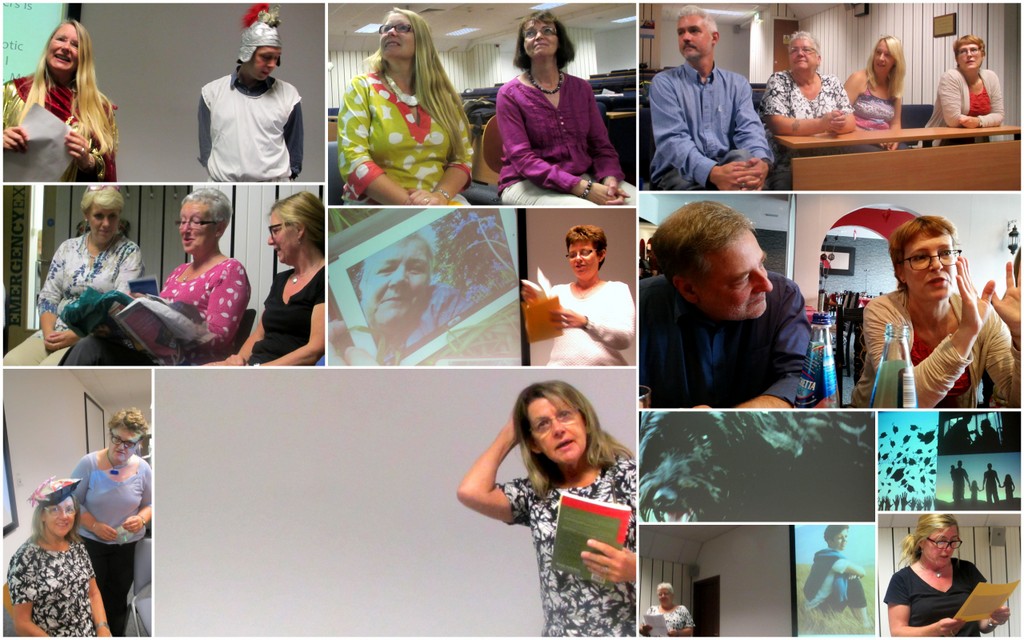
The newly formed ARTS in Research Collaborative recently held two days of exploration of biography and ways and means of expressing the stories of others creatively and ethically. The workshop was entitled, A Past/A Present” ARTS in Research (AiR) Workshop.

Using shared objects representing a time or event in each participant’s life, a ‘partner’ then created a five minute presentation of and from the storied materials. Participants in the two-days of exploration came from HSC, the Media School and DEC. Both faculty and postgrad students took part.

The brief was kept simple and instruction to a minimum. Organiser Kip Jones shared examples from his own work of finding ways and means of responding creatively to detailed data as well as time and material constraints. Other than that, participants engaged in a learning process through participation itself and the sharing of their experiences.

  • “Thank you all for the incredible willingness to be inventive, creative and think/be  outside ‘the box’”.
  • “An illuminating two days of deep sharing. I was honoured to be there and look forward to more creative adventures together”.
  • “Inspiring. An artful and generative suspension of ‘normal’ activity”.
Telling stories

The ARTS in Research Collaborative’s next workshop is planned for November at The Lighthouse in Poole. Details to follow. It will be open to a wider audience and there will be a charge to attend.


“I can’t remember ever attending such an inspiring event ‘in house’”.

The newly formed ARTS in Research Collaborative recently held two days of exploration of biography and ways and means of expressing the stories of others creatively and ethically. The workshop was entitled, A Past/A Present” ARTS in Research (AiR) Workshop.
Using shared objects representing a time or event in each participant’s life, a ‘partner’ then created a five minute presentation of and from the storied materials. Participants in the two-days of exploration came from HSC, the Media School and DEC. Both faculty and postgrad students took part.
The brief was kept simple and instruction to a minimum. Organiser Kip Jones shared examples from his own work of finding ways and means of responding creatively to detailed data as well as time and material constraints. Other than that, participants engaged in a learning process through participation itself and the sharing of their experiences. The group has agreed to write up the encounter for a journal article.

  • “Thank you all for the incredible willingness to be inventive, creative and think/be  outside ‘the box’”.

  • “An illuminating two days of deep sharing. I was honoured to be there and look forward to more creative adventures together”.

  • “Inspiring. An artful and generative suspension of ‘normal’ activity”.

The ARTS in Research Collaborative’s next workshop is planned for November at The Lighthouse in Poole. Details to follow. It will be open to a wider audience and there will be a charge to attend, but BU faculty and students are encouraged to apply for training and/or development funding within their Schools.

ARTS in Research (AiR) still accepting new members!

- See more at: http://blogs.bournemouth.ac.uk/research/2014/09/07/arts-in-research-air-collaborative-two-days-of-creative-scholarship/#sthash.BZJnmzp9.dpuf

“I can’t remember ever attending such an inspiring event ‘in house’”.

The newly formed ARTS in Research Collaborative recently held two days of exploration of biography and ways and means of expressing the stories of others creatively and ethically. The workshop was entitled, A Past/A Present” ARTS in Research (AiR) Workshop.
Using shared objects representing a time or event in each participant’s life, a ‘partner’ then created a five minute presentation of and from the storied materials. Participants in the two-days of exploration came from HSC, the Media School and DEC. Both faculty and postgrad students took part.
The brief was kept simple and instruction to a minimum. Organiser Kip Jones shared examples from his own work of finding ways and means of responding creatively to detailed data as well as time and material constraints. Other than that, participants engaged in a learning process through participation itself and the sharing of their experiences. The group has agreed to write up the encounter for a journal article.

  • “Thank you all for the incredible willingness to be inventive, creative and think/be  outside ‘the box’”.

  • “An illuminating two days of deep sharing. I was honoured to be there and look forward to more creative adventures together”.

  • “Inspiring. An artful and generative suspension of ‘normal’ activity”.

The ARTS in Research Collaborative’s next workshop is planned for November at The Lighthouse in Poole. Details to follow. It will be open to a wider audience and there will be a charge to attend, but BU faculty and students are encouraged to apply for training and/or development funding within their Schools.

ARTS in Research (AiR) still accepting new members!


AiR Workshop: telling stories (click on photo to enlarge)
- See more at: http://blogs.bournemouth.ac.uk/research/2014/09/07/arts-in-research-air-collaborative-two-days-of-creative-scholarship/#sthash.BZJnmzp9.dpuf

“I can’t remember ever attending such an inspiring event ‘in house’”.

The newly formed ARTS in Research Collaborative recently held two days of exploration of biography and ways and means of expressing the stories of others creatively and ethically. The workshop was entitled, A Past/A Present” ARTS in Research (AiR) Workshop.
Using shared objects representing a time or event in each participant’s life, a ‘partner’ then created a five minute presentation of and from the storied materials. Participants in the two-days of exploration came from HSC, the Media School and DEC. Both faculty and postgrad students took part.
The brief was kept simple and instruction to a minimum. Organiser Kip Jones shared examples from his own work of finding ways and means of responding creatively to detailed data as well as time and material constraints. Other than that, participants engaged in a learning process through participation itself and the sharing of their experiences. The group has agreed to write up the encounter for a journal article.

  • “Thank you all for the incredible willingness to be inventive, creative and think/be  outside ‘the box’”.

  • “An illuminating two days of deep sharing. I was honoured to be there and look forward to more creative adventures together”.

  • “Inspiring. An artful and generative suspension of ‘normal’ activity”.

The ARTS in Research Collaborative’s next workshop is planned for November at The Lighthouse in Poole. Details to follow. It will be open to a wider audience and there will be a charge to attend, but BU faculty and students are encouraged to apply for training and/or development funding within their Schools.

ARTS in Research (AiR) still accepting new members!


AiR Workshop: telling stories (click on photo to enlarge)
- See more at: http://blogs.bournemouth.ac.uk/research/2014/09/07/arts-in-research-air-collaborative-two-days-of-creative-scholarship/#sthash.BZJnmzp9.dpuf

“I can’t remember ever attending such an inspiring event ‘in house’”.

The newly formed ARTS in Research Collaborative recently held two days of exploration of biography and ways and means of expressing the stories of others creatively and ethically. The workshop was entitled, A Past/A Present” ARTS in Research (AiR) Workshop.
Using shared objects representing a time or event in each participant’s life, a ‘partner’ then created a five minute presentation of and from the storied materials. Participants in the two-days of exploration came from HSC, the Media School and DEC. Both faculty and postgrad students took part.
The brief was kept simple and instruction to a minimum. Organiser Kip Jones shared examples from his own work of finding ways and means of responding creatively to detailed data as well as time and material constraints. Other than that, participants engaged in a learning process through participation itself and the sharing of their experiences. The group has agreed to write up the encounter for a journal article.

  • “Thank you all for the incredible willingness to be inventive, creative and think/be  outside ‘the box’”.

  • “An illuminating two days of deep sharing. I was honoured to be there and look forward to more creative adventures together”.

  • “Inspiring. An artful and generative suspension of ‘normal’ activity”.

The ARTS in Research Collaborative’s next workshop is planned for November at The Lighthouse in Poole. Details to follow. It will be open to a wider audience and there will be a charge to attend, but BU faculty and students are encouraged to apply for training and/or development funding within their Schools.

ARTS in Research (AiR) still accepting new members!


AiR Workshop: telling stories (click on photo to enlarge)
- See more at: http://blogs.bournemouth.ac.uk/research/2014/09/07/arts-in-research-air-collaborative-two-days-of-creative-scholarship/#sthash.BZJnmzp9.dpuf

“I can’t remember ever attending such an inspiring event ‘in house’”.

The newly formed ARTS in Research Collaborative recently held two days of exploration of biography and ways and means of expressing the stories of others creatively and ethically. The workshop was entitled, A Past/A Present” ARTS in Research (AiR) Workshop.
Using shared objects representing a time or event in each participant’s life, a ‘partner’ then created a five minute presentation of and from the storied materials. Participants in the two-days of exploration came from HSC, the Media School and DEC. Both faculty and postgrad students took part.
The brief was kept simple and instruction to a minimum. Organiser Kip Jones shared examples from his own work of finding ways and means of responding creatively to detailed data as well as time and material constraints. Other than that, participants engaged in a learning process through participation itself and the sharing of their experiences. The group has agreed to write up the encounter for a journal article.

  • “Thank you all for the incredible willingness to be inventive, creative and think/be  outside ‘the box’”.

  • “An illuminating two days of deep sharing. I was honoured to be there and look forward to more creative adventures together”.

  • “Inspiring. An artful and generative suspension of ‘normal’ activity”.

The ARTS in Research Collaborative’s next workshop is planned for November at The Lighthouse in Poole. Details to follow. It will be open to a wider audience and there will be a charge to attend, but BU faculty and students are encouraged to apply for training and/or development funding within their Schools.

ARTS in Research (AiR) still accepting new members!


AiR Workshop: telling stories (click on photo to enlarge)
- See more at: http://blogs.bournemouth.ac.uk/research/2014/09/07/arts-in-research-air-collaborative-two-days-of-creative-scholarship/#sthash.BZJnmzp9.dpuf

Sunday, 15 August 2010

My mother’s death/falling in love again


"The sweat on their bodies”


I was introduced to live musical theatre at the Valley Forge Music Fair. It was summer stock for New York actors, singers and dancers performed in a tent on the East coast of Pennsylvania, outside of Philadelphia.

I lived my simple, country boy life about 30 miles to the west. It was at Valley Forge that I saw shows like Pajama Game and Damn Yankees and, for the first time, fell in love with live musical theatre.


Theatre in the round and being so close to the sweat on the dancers’ bodies made me believe that there was a possibility of connecting somehow. As a teenager, these theatrical encounters were a part of my growing-up world of serious sexual awakening. I had put aside my childish desire to be Robin to Batman or follow Flash Gordon around in his lamé hot pants. These new experiences were comprised of all the senses; but mostly, it was the smell of the greasepaint mixed with the dancers’ sweat. I was breathless from the experience.


Every summer I would look forward to these performances under that tent, the actors in such intimate proximity, darting up and down the aisles, making their exits and entrances. The tension of wanting to reach out and touch them was palatable.


I would hang around the parking lot after the shows, hoping that one of the cast would come along and say hello. I lie. Come along and take me away with them. I wanted to join this musical circus; I wanted to fall in love and get laid. I still get these three things mixed up.


Spiegeltent has arrived at the Edinburgh International Festival with great success. This year it will host a new range of sideshow acts, cabaret and spectacles.


Spiegeltents are hand-hewn pavilions used as travelling dance halls, bars and entertainment salons since they were created in the early 20th century . There are only a hand-full of these unique and legendary ‘tents of mirrors’ left in the world today. The performances at Edinburgh’s Spiegeltent are live, in the round and under canvass.

Marlene Dietrich sang ‘Falling In Love Again’ on its famous stage in the 1930’s and, since then, its magic mirrors have reflected thousands of images of artists, audiences and exotic gatherings. It’s old Cabaret magic that has somehow become new again. It reminds me of my youthful awakening.

Speaking of Falling In Love Again, I did. Not that I expected to. He is a Russian dancer on a ship. We first met three years ago. I have been extremely guarded with my emotions since our first encounter. We see each other infrequently—two or three times a year. The story, retold as it heated up recently, unfolds below:


A conceptual narrative diary compiled from daily Facebook entries:

News Feed


. Time for the sea again....

· I should stop pretending it's luggage and just call them costumes.


· Sea day today. He is dancing his 'starring' role tonight. Me, organising my own costumes for the voyage. Stockholm tomorrow.


· Have to go now. Lunch date with the dancers tomorrow and not a thing to wear.


· 'The real voyage of discovery consists not in seeking new lands, but in seeing with new eyes.' –Marcel Proust


· He wants me to meet him at midnight. I am getting too old for this.


· Actually it was magical and moving. Overcoming my tendency towards inaction has been a theme in my life. In reality, it has brought me every reward.


· Having lunch with him today at the ship’s Ben Brittan restaurant; it's become a bit of a tradition.


·Things are getting very close to the edge.


· Someone said: 'Explain this to me'. I said, 'When I was sixteen I swam across a three-mile lake and back. These days I am happy when I can do a couple of laps in the pool. The same for emotional life, really'.


· In spite of all my best effort, planning and resistance, I am a bit lovesick.


· Remembering Carol K and her admonishment, after listening to my tales of love sickness: ‘Yeah, but did you get a painting out of it?’


· Time to forget, put aside and plough on with all of the projects and problems that I left behind. In a way, they will be a welcomed distraction.


· Do I dare? Have I lost my marbles?


· I constantly watch the ship’s webcam now. I watch the ensign change position on the bow. I make mental notes of the breezes. (Get a life, Kip.)


· Sunny, very little wind or activity. Ship in front is refuelling.


Fedor Tyutchev, Russian poet:

Я встретил вас - и все былое
В отжившем сердце ожило;
Я вспомнил время, время золотое -
И сердцу стало так тепло...


I met you and the past


came back to life in my dead heart.


Remembering a golden time,


my heart became so warm.


· The Baltic Sea is peaceful and blue, the sun refusing to set so far North. It’s almost 10:30 pm. He is about to start the second show, most likely.


· Should I be like a Brit and take a mini-holiday on the Bank Holiday weekend? Should I? Should I just turn up on the ship? Should I?


· Decision made. Нравится ли вам сюрпризы? (Do you like surprises?)


· Good-bye, Bette. You're with Dad now.


· ’Everything that passes away is only a reflection...' –Mahler’s 8th

______________________________________

Part of my intention in constructing a book out of a seemingly haphazard collection of notes was that these notes, by virtue of their accumulation and juxtaposition and patternation, would end up working overtime (not unlike what we might expect of the bits and pieces of a conceptual art’). –The Conceptual Novel: Michael Kimball Interviews Evan Lavender-Smith