Kip Jones

KIP JONES, an American by birth, has been studying and working in the UK for more than 20 years.
Under the umbrella term of 'arts-led research', his main efforts have involved developing tools
from the arts and humanities for use by social scientists in research and its impact on a wider
public or a Perfomative Social Science.

Jones was Reader in Performative Social Science and Qualitative Research at
Bournemouth University for 15 years.
He is now a Visiting Scholar and and an independent author and scholar.

Kip has produced films and written many articles for academic journals and authored chapters
for books on topics such as masculinity, ageing and rurality, and older LGBT citizens.
Jones' most recent work involves working with Generation Z youth to tell their stories using
social media.
His ground-breaking use of qualitative methods, including Auto-fiction, biography
and auto-ethnography, and the use of tools from the arts in social science research
and dissemination are well-known.

Jones acted as Author and Executive Producer of
the award-winning short film, RUFUS STONE, funded by Research Councils UK.
The film is now available for free viewing on the Internet
and has been viewed by more than 14,000 people in 150 countries.

Areas of expertise
• Close relationships, culture and ethnicity
• Social psychology, sociology
• Ageing, self and identity
• Interpersonal processes, personality,
individual differences,
social networks, prejudice and stereotyping
• Sexuality and sexual orientation
• Creativity and the use of the
arts in Social Science

Media experience
His work has been reported widely
in the media, including:
BBC Radio 4,BBC TV news,Times
Higher Education, Sunday New
York Times, International
Herald-Tribune
and The Independent.

Thursday, 18 September 2014

(The Grand Theory of) Neo Emotivism


 Malevich, “Black Suprematic Square”, 1915, oil on linen, 79.5 x 79.5 cm,

“The things that I want to communicate are simply self-evident, emotional things. And the gifts of those things are that they bring both intellectual and emotional gifts — understanding”. Jeff Buckley, singer (Interview with Luisa Cortado, 1995) 

[Download the entire paper here] 

The paper also appeared in Social Science Space


Neo Emotivism. You heard it here first. If I am ever going to come up with a Grand Theory, (in spite of years of denying the possibility of that very construct in a post-modern world), this is it!
  •     There is a New Emotivity emergent in academia worth exploring.

  •     Time and time again, when given the opportunity, scholars long to connect emotionally with the people about whom they are writing.

  •     The difficulty encountered for academics wishing to write creatively is that we are programmed to repeat (endlessly) what we've read to establish “validity”.

  •     When you write to provoke (arouse) readers emotionally, don't mimic words you've read to do it. Instead, chose unique words that equal your experience.

  •     Scholars realising the soundness of their emotional connectivity need to find their own language to express feeling—a new language not simply justified by the idiom preceding them.

  •  

Can we move on?
My thinking around the concept of Neo Emotivism began to solidify recently, brought on by two things: a short descriptive phrase about Max Richter's music and an ARTS in Research workshop at Bournemouth University. Allow me to elaborate.


When I read that Max Richter’s minimalist composition for the TV series, The Leftovers, was tagged as ‘Neo-Romantic’ in a promo, I was startled. “Neo-Romantic? How is minimalist music romantic?”  And then I started to realise that it is the same emotional response that I have to Richter’s music that I have to Chopin or Mendelssohn. 

“What is ‘Romanticism’ in music composition?” I wondered. ‘Characteristics often attributed to Romanticism … are:

  •        a new preoccupation with and surrender to Nature
  •        a fascination with the past…
  •        a turn towards the mystic and supernatural 
  •        a longing for the infinite
  •        mysterious connotations of remoteness, the unusual and fabulous, the strange and surprising
  •        a focus on the nocturnal, the ghostly, the frightful, and terrifying
  •        fantastic seeing and spiritual experiences
  •        a new attention given to national identity
  •        emphasis on extreme subjectivism
  •        interest in the autobiographical
  •        discontent with … formulas and conventions’
(Kravitt 1992, 93–94, 107 cited in http://en.wikipedia.org/wiki/Romantic_music)

These qualities resonate with the characteristics we might look for in Neo Emotivism. There! A checklist.


Can we move on?
The penny began to drop when the Bournemouth University ARTS in Research collaborative met up recently for those two days of experimentation. I am familiar with health and social care academics having a proclivity towards sensitivity to the often-emotional stories of others gleaned through their investigative encounters. What surprised and encouraged me were faculty and students from Media, Design, Engineering and Computing and Tourism with the same ache to connect emotionally with their subjects and to acknowledge the “first person” in their dialogues.


Perhaps we should look for inspiration to the New Romantics of the late 1970s, with their shoulder pads and quiffed hair?  Ziggie Stardust and synthpop? There is a sweet nostalgia often present in my informal biographic encounters with fellow academics, wistful for the days of David Bowie and Kate Bush. Their recollections are often about how we used to be before we were led to believe that we needed to behave (differently). It’s life pre-RAE and REF—the “preREFaelites”, to coin a phrase.  It is often reminiscence about a time in our shared lives of both emotional conflict and emotional connect.

Indeed, scholars often find their own narratives in the stories that people tell them for their research. A big part of Neo Emotivism is embracing this phenomenon instead of backing away from it. The relationships that can be established through such connections are potent and comprised of more than the sum of their parts.

Changing hearts and minds was central to my reasons for making the short film RUFUS STONE and I have written about this elsewhere. I realised quite early in the research process for the film that debate, argument, or evidence—none of these by itself was going to change the opinions of some of the hardheaded bigots in our midst. Should we attempt an emotional appeal, even attempt to provoke an emotive disturbance? Would we then have a chance at changing hearts and minds?


I recently watched a BBC 4 programme with architect Zada Hadid in which she explained how her work has roots in an art movement that is 100 years old. She has long cited the Russian abstract artist Kazimir Malevich as one of her greatest inspirations. Her experience offers a clue to the very way in which arts-based researchers might explore outside their own turf to enrich their present efforts. Hadid found her inspiration from painting in another era, not by simply replicating what was au courant at the moment in her chosen field of architecture. If we continue to only imitate what has directly preceded us in our creative academic endeavours, we will never produce the forward movements in scholarship necessary for change and innovation.  As a student, Hadid bravely embraced Malevich as inspiration and flew with it.  Actually, much of her architecture today looks like it is floating or flying. Studying Malevich opened up vast possibilities for her creative explorations and still influences the way in which she works today.

The early waves of renewed interest in qualitative and narrative approaches (or the qualitative and narrative “turns” in research as they were called in the early 1990s) established protocols, procedures, and a language that, by now, are repeated habitually. Perhaps it time now to look elsewhere, (to culture, to the arts, to literature, etc. both past and present), to find fresh inspiration and vocabulary to support our new emotive efforts. For example, I often recommend that academics read the contemporary fiction of conceptual novelists such as Michael Kimball in order to unleash creativity and a new, uncluttered way of using language in their academic writing. Should we continue to routinely repeat what are by now shop-worn words in our academic out-pourings such as ‘rigour’, ‘robust’, ‘thick’, ‘embodied’ and ‘evocative’ to support (or deny?) our emotive tendencies? Most of those words have been repeated ad infinitum for more than 20 years now, degenerating into no more than code words signalling membership in a particular scholarly community. They have become words without force.


Can we move on?
The first step in reporting emotive encounters in research, therefore, is moving away from concepts that have evolved from measurement—terms like ‘empathic validity’,  'reliability', etc. Rejecting the use of statistical language to describe the emotional components of our labours is key to communicating an understanding of the How’s and Why’s of the human condition. The second step is to find our own individual language (a descriptive and poetic one?) that does not mimic the status quo language of a specific scholarship simply because of our insecurities or longing to fit in with a particular club or movement. 

Acknowledging the emotive connections in our work doesn’t mean simply producing wishy-washy, touchy-feely texts either. In fact, Neo Emotivism insists upon tougher, more resilient, profoundly compassionate yet hard-hitting, productions. This is accomplished through the creative use of language—textural/visual/physical—or some new mode of communication that we haven’t even attempted yet.
 

An emotional response by a scholar need not be validated like a parking ticket. 

Feelings aren’t the same as facts.
As Jeff Buckley said, ‘The gifts of those things are that they bring both intellectual and emotional gifts — understanding.’

Neo Emotivism may very well cause a riot … or a revolution!

“Let a thousand flowers bloom …”


Download the paper here

Sunday, 7 September 2014

Update on ARTS in Research (AiR) Collaborative: Two days of creative scholarship


“I can’t remember ever attending such an inspiring ‘in house’ event ”.
Shared objects/stories of a past


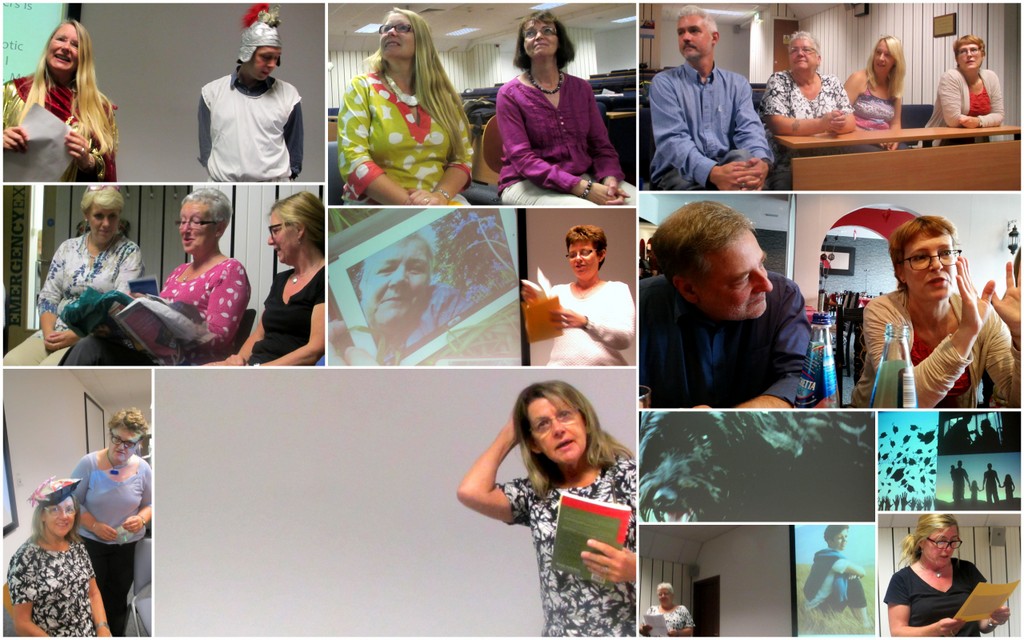
The newly formed ARTS in Research Collaborative recently held two days of exploration of biography and ways and means of expressing the stories of others creatively and ethically. The workshop was entitled, A Past/A Present” ARTS in Research (AiR) Workshop.

Using shared objects representing a time or event in each participant’s life, a ‘partner’ then created a five minute presentation of and from the storied materials. Participants in the two-days of exploration came from HSC, the Media School and DEC. Both faculty and postgrad students took part.

The brief was kept simple and instruction to a minimum. Organiser Kip Jones shared examples from his own work of finding ways and means of responding creatively to detailed data as well as time and material constraints. Other than that, participants engaged in a learning process through participation itself and the sharing of their experiences.

  • “Thank you all for the incredible willingness to be inventive, creative and think/be  outside ‘the box’”.
  • “An illuminating two days of deep sharing. I was honoured to be there and look forward to more creative adventures together”.
  • “Inspiring. An artful and generative suspension of ‘normal’ activity”.
Telling stories

The ARTS in Research Collaborative’s next workshop is planned for November at The Lighthouse in Poole. Details to follow. It will be open to a wider audience and there will be a charge to attend.


“I can’t remember ever attending such an inspiring event ‘in house’”.

The newly formed ARTS in Research Collaborative recently held two days of exploration of biography and ways and means of expressing the stories of others creatively and ethically. The workshop was entitled, A Past/A Present” ARTS in Research (AiR) Workshop.
Using shared objects representing a time or event in each participant’s life, a ‘partner’ then created a five minute presentation of and from the storied materials. Participants in the two-days of exploration came from HSC, the Media School and DEC. Both faculty and postgrad students took part.
The brief was kept simple and instruction to a minimum. Organiser Kip Jones shared examples from his own work of finding ways and means of responding creatively to detailed data as well as time and material constraints. Other than that, participants engaged in a learning process through participation itself and the sharing of their experiences. The group has agreed to write up the encounter for a journal article.

  • “Thank you all for the incredible willingness to be inventive, creative and think/be  outside ‘the box’”.

  • “An illuminating two days of deep sharing. I was honoured to be there and look forward to more creative adventures together”.

  • “Inspiring. An artful and generative suspension of ‘normal’ activity”.

The ARTS in Research Collaborative’s next workshop is planned for November at The Lighthouse in Poole. Details to follow. It will be open to a wider audience and there will be a charge to attend, but BU faculty and students are encouraged to apply for training and/or development funding within their Schools.

ARTS in Research (AiR) still accepting new members!

- See more at: http://blogs.bournemouth.ac.uk/research/2014/09/07/arts-in-research-air-collaborative-two-days-of-creative-scholarship/#sthash.BZJnmzp9.dpuf

“I can’t remember ever attending such an inspiring event ‘in house’”.

The newly formed ARTS in Research Collaborative recently held two days of exploration of biography and ways and means of expressing the stories of others creatively and ethically. The workshop was entitled, A Past/A Present” ARTS in Research (AiR) Workshop.
Using shared objects representing a time or event in each participant’s life, a ‘partner’ then created a five minute presentation of and from the storied materials. Participants in the two-days of exploration came from HSC, the Media School and DEC. Both faculty and postgrad students took part.
The brief was kept simple and instruction to a minimum. Organiser Kip Jones shared examples from his own work of finding ways and means of responding creatively to detailed data as well as time and material constraints. Other than that, participants engaged in a learning process through participation itself and the sharing of their experiences. The group has agreed to write up the encounter for a journal article.

  • “Thank you all for the incredible willingness to be inventive, creative and think/be  outside ‘the box’”.

  • “An illuminating two days of deep sharing. I was honoured to be there and look forward to more creative adventures together”.

  • “Inspiring. An artful and generative suspension of ‘normal’ activity”.

The ARTS in Research Collaborative’s next workshop is planned for November at The Lighthouse in Poole. Details to follow. It will be open to a wider audience and there will be a charge to attend, but BU faculty and students are encouraged to apply for training and/or development funding within their Schools.

ARTS in Research (AiR) still accepting new members!


AiR Workshop: telling stories (click on photo to enlarge)
- See more at: http://blogs.bournemouth.ac.uk/research/2014/09/07/arts-in-research-air-collaborative-two-days-of-creative-scholarship/#sthash.BZJnmzp9.dpuf

“I can’t remember ever attending such an inspiring event ‘in house’”.

The newly formed ARTS in Research Collaborative recently held two days of exploration of biography and ways and means of expressing the stories of others creatively and ethically. The workshop was entitled, A Past/A Present” ARTS in Research (AiR) Workshop.
Using shared objects representing a time or event in each participant’s life, a ‘partner’ then created a five minute presentation of and from the storied materials. Participants in the two-days of exploration came from HSC, the Media School and DEC. Both faculty and postgrad students took part.
The brief was kept simple and instruction to a minimum. Organiser Kip Jones shared examples from his own work of finding ways and means of responding creatively to detailed data as well as time and material constraints. Other than that, participants engaged in a learning process through participation itself and the sharing of their experiences. The group has agreed to write up the encounter for a journal article.

  • “Thank you all for the incredible willingness to be inventive, creative and think/be  outside ‘the box’”.

  • “An illuminating two days of deep sharing. I was honoured to be there and look forward to more creative adventures together”.

  • “Inspiring. An artful and generative suspension of ‘normal’ activity”.

The ARTS in Research Collaborative’s next workshop is planned for November at The Lighthouse in Poole. Details to follow. It will be open to a wider audience and there will be a charge to attend, but BU faculty and students are encouraged to apply for training and/or development funding within their Schools.

ARTS in Research (AiR) still accepting new members!


AiR Workshop: telling stories (click on photo to enlarge)
- See more at: http://blogs.bournemouth.ac.uk/research/2014/09/07/arts-in-research-air-collaborative-two-days-of-creative-scholarship/#sthash.BZJnmzp9.dpuf

“I can’t remember ever attending such an inspiring event ‘in house’”.

The newly formed ARTS in Research Collaborative recently held two days of exploration of biography and ways and means of expressing the stories of others creatively and ethically. The workshop was entitled, A Past/A Present” ARTS in Research (AiR) Workshop.
Using shared objects representing a time or event in each participant’s life, a ‘partner’ then created a five minute presentation of and from the storied materials. Participants in the two-days of exploration came from HSC, the Media School and DEC. Both faculty and postgrad students took part.
The brief was kept simple and instruction to a minimum. Organiser Kip Jones shared examples from his own work of finding ways and means of responding creatively to detailed data as well as time and material constraints. Other than that, participants engaged in a learning process through participation itself and the sharing of their experiences. The group has agreed to write up the encounter for a journal article.

  • “Thank you all for the incredible willingness to be inventive, creative and think/be  outside ‘the box’”.

  • “An illuminating two days of deep sharing. I was honoured to be there and look forward to more creative adventures together”.

  • “Inspiring. An artful and generative suspension of ‘normal’ activity”.

The ARTS in Research Collaborative’s next workshop is planned for November at The Lighthouse in Poole. Details to follow. It will be open to a wider audience and there will be a charge to attend, but BU faculty and students are encouraged to apply for training and/or development funding within their Schools.

ARTS in Research (AiR) still accepting new members!


AiR Workshop: telling stories (click on photo to enlarge)
- See more at: http://blogs.bournemouth.ac.uk/research/2014/09/07/arts-in-research-air-collaborative-two-days-of-creative-scholarship/#sthash.BZJnmzp9.dpuf

“I can’t remember ever attending such an inspiring event ‘in house’”.

The newly formed ARTS in Research Collaborative recently held two days of exploration of biography and ways and means of expressing the stories of others creatively and ethically. The workshop was entitled, A Past/A Present” ARTS in Research (AiR) Workshop.
Using shared objects representing a time or event in each participant’s life, a ‘partner’ then created a five minute presentation of and from the storied materials. Participants in the two-days of exploration came from HSC, the Media School and DEC. Both faculty and postgrad students took part.
The brief was kept simple and instruction to a minimum. Organiser Kip Jones shared examples from his own work of finding ways and means of responding creatively to detailed data as well as time and material constraints. Other than that, participants engaged in a learning process through participation itself and the sharing of their experiences. The group has agreed to write up the encounter for a journal article.

  • “Thank you all for the incredible willingness to be inventive, creative and think/be  outside ‘the box’”.

  • “An illuminating two days of deep sharing. I was honoured to be there and look forward to more creative adventures together”.

  • “Inspiring. An artful and generative suspension of ‘normal’ activity”.

The ARTS in Research Collaborative’s next workshop is planned for November at The Lighthouse in Poole. Details to follow. It will be open to a wider audience and there will be a charge to attend, but BU faculty and students are encouraged to apply for training and/or development funding within their Schools.

ARTS in Research (AiR) still accepting new members!


AiR Workshop: telling stories (click on photo to enlarge)
- See more at: http://blogs.bournemouth.ac.uk/research/2014/09/07/arts-in-research-air-collaborative-two-days-of-creative-scholarship/#sthash.BZJnmzp9.dpuf

Thursday, 28 August 2014

"A Past/A Present" ARTS in Research (AiR) Workshop at Bournemouth

The AiR collaborative at Bournemouth will be gathering in a week to experiment with the stories of others and how to represent them using various media. Participation in the two-day workshop is closed now, but others are welcome to the concept and to experiment with it themselves.

The instructions are simple:
The ARTS in Research (AiR) Collaborative would like you to contribute to an experiment. Please bring your past as a present to the workshop. You will give it to someone else. They get to keep it.

Look through that box at the back of the wardrobe or in the loft—the one with bits and pieces that you have been unable to throw away because they represent you and your past.  You are going to give some of them away now.

Find some of those precious objects to include in a small packet.

Objects might include a paperback novel, pamphlets, railroad tickets, stamps, old letters or
photographs (from when photographs used to be physical things), a mix-tape cassette (still have
any?) or a 45 record, a food stained recipe card, a small piece of clothing, an accessory like a ribbon or a badge, sheet music, keys, post cards, used concert or theatre tickets, a self-penned poem or a song, or a drawing. Select a few of the objects that tell a particular story from a particular time in your life. Finally, find a box or something else to put them in or wrap them in. Wrap them lovingly, using beautiful materials, perhaps ones that you also have collected. No more than could fill a cigar box or a shoebox at most.

Bring your gift to the workshop. You will agree to exchange presents with one person, someone chosen for you by random. You will talk to each other, telling each other stories about the contents. You might make some notes, but be a good listener/observer. After eating lunch with your partner, we will gather to begin to create individual projects around the earlier exchanges.

Day Two: will be ‘Show & Tell’ –more show than tell. You will present your partner’s story in 5 minutes using any media of your choosing that is convenient. You may want to have your phone, your iPad, your laptop with you. These will be ‘narrative postcards’ of the stories that you have experienced.

Purpose
Two-day Workshop on Biography, Narrative and Arts-based approaches to collecting and
disseminating the personal stories of others by using our own.
  Other than listening, how do we gather life stories?
• Other than dry academic reports, how can we retell these stories in a sensitive
and ethical way to wider audiences?
• How do the stories themselves inspire creativity in retelling them?
• How can we involve participants in the retelling of their stories?
• How much of their story is also our story?
• When is the gathering of the story itself, itself the story?
• How willing are we to let go of our selves?
Benefits
• Form new relationships with colleagues across disciplines and Schools.
• Experiment with arts-based methods to represent/disseminate research findings.
• Develop more participatory relationships/collaborations with research participants.
• Develop visual and tactile methods of gathering data using all of the senses.

 “It’s difficult to draw a line between the past
and the present –awfully difficult” –Little Edie,
Maysles Brothers’ documentary,
Grey Gardens


Sunday, 17 August 2014

Amy Genders Questions Kip about Academic Blogging

-->
By Amy Genders


Q&A: Kip Jones on the Art of Academic Blogging
Posted on August 12, 2014


I recently interviewed Jones to find out more about how he uses social media to share his research and his advice for other academics who want to try their hand at blogging.

You have created quite a prolific online presence with regular blog updates and use of Facebook and Twitter to share your research. Why is this important to you?
I have always been keen to reach wider audiences with my work, both my academic and creative outputs. It seems a shame to spend months, sometimes years, working on a project, only to have it end up on a library shelf or in an academic repository. I first used a personal website to get my work out there in combination with email newsgroups. When social media came along, I then began to experiment with Facebook and then Twitter as well to build audiences for my work.

A good example is my PhD Thesis, which I uploaded to my website at least ten years ago now with little interest then. In the past year or so it has also been uploaded to Academia.edu where it has now been viewed more than 700 times. This did not happen not only because of the site, but also because I frequently tweet about it and post it on Facebook as well. The fact that an 80,000 word document can generate this kind of attention is, quite frankly, mind boggling and demonstrates the strength of both social media and the impact of open access publication resources more generally.

My watchwords for social media are ‘Repetition, repetition, repetition!’ Don’t expect an audience to necessarily see your post the first time and don’t forget that they live in different global time zones. I have also been experimenting with what are called ‘tag lines’ in film distribution in writing 140 character tweets for Twitter. Creativity helps in getting attention in a very fast moving (and limited attention span) social media audience such as Twitter! And followers: be good to your followers and don’t forget to retweet their posts as well. Retweets build the audience, I have found.

The film based on your research, ‘Rufus Stone’, has been featured in such media outlets as The New York Times and BBC Radio 4’s Thinking Allowed. What role has social media, such as Twitter and Facebook, played in promoting your work and engaging with wider audiences outside of academia?

In terms of the NY Times or Radio 4, I think ‘networking’ more generally was responsible for those successes. It really was a case of who do you know and more importantly who knows about you. I suppose social media helps a bit too and the Radio 4 producer still follows my tweets as does a reporter from Times Higher Education. So I would say it is mix of networking and always keeping up contacts through social media, which is easier and bit less off-putting then barraging reporters with email messages. If you have an idea for a story for a media outlet, a direct message through Twitter or Facebook is many times enough to create interest, without being too ‘self-promoting’.

Your blog KIPWORLD covers a range of topics from advice on writing a PhD thesis, to insight into your creative process. What advice would you give to other academics wanting to start their own blog?

KIPWORLD profoundly changed the way I write academically. I stepped into the waters of blog writing a bit sheepishly at first, trying to find both my style and what I might write about. I definitely did not want to make my blog a daily diary of my life or work (and I don’t have a cat). I tend to painstakingly write and rewrite anyway, so putting something out frequently was never going to work for me. I still write for my blog about once a month, although I now write for other blogs from time to time (LSE Impact blog, LSE Review of Books, Discovery Society, Sociological Imagination, Creative Quarter, The Creativity Post, Bournemouth University Research Blog) as well.

At the same time as I was beginning to write KIPWORLD, I was also turning to contemporary fiction writers (mostly to help with writing RUFUS STONE’s backstory). I particularly was attracted to the ‘Conceptual Novel’ approach of writers like Michael Kimball. His lean style and exquisite choice of phrase attracted me because it is similar to the necessity of brevity in script-writing.

Because I was also writing about my own story in constructing RUFUS STONE, I began to use the blog to write about my past as well. I began to develop what I call a ‘fictive reality’ or fiction based in a remembered past. At one point I realised that I had written creative fiction for the blog 11 times over five years and compiled it as one piece, Creative Writing Eleven (short) Stories from KIPWORLD 2009-2013.

All of this experimentation affected my more academic writing almost by stealth; I was writing more clearly, more simply, even more creatively when writing for academic publication. Probably the best example of this is: Infusing Biography with the Personal: Writing RUFUS STONE first published in the journal, Creative Arts Research.

My advice to others? Find your own voice, even your own subject material. Use your blog to develop your writing and your own style. Don’t just assume that it has to look and sound like a blog to be one. Include at least one picture with every blog article. Let people know about the blog through social media—don’t expect an audience to just find it on its own. Promote it. If the most important thing in your life IS to write about your cat, write about it as creatively as you possibly can. Enjoy the experience!

Reposted by permission from Amy Genders' Arts on Television blog. 

Monday, 21 July 2014

On creativity, scholarship and making a Hollywood film

Kip Jones with cast and crew on the set of RUFUS STONE

Two offerings from the pen of Kip Jones join the blogosphere:

Breaking Boundaries: An Arabesque on Art, Creativity and Scholarship” brings Jones and author, Patricia Leavy, together again for a follow-up discusssion based on their earlier ‘Twenty Questions” –both published by The Creativity Post.
The second piece in Creativity Bites, “Once Upon a Time on the Set with John Huston”, recalls Jones’ own experience as a student working with a Hollywood director, crew and cast on the shoot for a film for Philadelphia’s Independence National Park in the 1970s (which is still screened for visitors to the Park). Jones relates this earlier experience with the more recent one of making the research-based biopic, RUFUS STONE at Bournemouth.

The element of Bournemouth student participation/co-production in making this film was highlighted in the BU 2013 Annual Report as ‘Inspirational’ by the University's Vice Chancellor.

Wednesday, 28 May 2014

A Brief Outline for Organising/Writing the PhD Thesis: Chapters I, II, & III

-->
The Research Question(s) are central and key to both the overall purpose and design of the Thesis. Each Chapter relates to them. The Intro sets up the problem(s) from which they arise and provides a map for the investigation. The Lit Review Chapter then investigates what is already known in relation to the research questions and convinces the reader that they are unanswered and need to be addressed. The Method Chapter establishes the researcher’s point-of-view within scholarship and methodology and then proceeds to consider various ways of answering the research questions within those parameters, finally arriving at the method chosen for the investigation and the reasons for it.

Chapter I: Introduction
A. Background (275 words[i]) (This is the section of the Introduction where first person can be used; perhaps how you became interested in the area of study, but not your life story [or employment history] here.)

B. Research Problem and Hypotheses (349 words) (This is crucial to establishing the whole raison d’etre of the study and the Thesis!) Make the reader/examiner as curious to find answers as you initially were!


C. Methodology (242 words) The plot of how you came to the method, rather than the method itself; that’s for later. Resist writing your full methodology here.

D. Justifications for the Research (177 words)
The research is also justified because its revelations and discovery add to and enrich …’

E. Outline of the Thesis (descriptions of the following, not details or argument) What the reader can expect.

1. Chapter Two: Review of the Literature (178 words)
2. Chapter Three: Method and Methodology (1184 words)
3. Chapter Four: Presentation of data (157 words)
4. Chapter Five: Analyses of data (167 words) (Four and Five are often combined)
5. Chapter Six: Conclusions and Implications (78 words)

F. Definitions (122 words)

G. Delimitations (234 words)

H. Conclusion

‘This introduction lays the foundations for the thesis.  It introduces the research problem, questions and hypotheses.  The research is justified, definitions are presented, the methodology is briefly described and justified, the thesis outlined and the limitations are given (c.f., Perry 1995).  On these foundations, the thesis can proceed with a detailed description of the research, beginning with a thorough exploratory examination of the literature on [the topic] in the following Chapter.’

Note: The Introduction is an overview, setting out the plan of action or map for the Thesis itself. It is not the place to go into detail about the how’s and why’s of either the questions, method(s) or findings, but rather, is descriptive of the processes that are to follow. This is not the place for argument or debate.


Chapter II: Literature Review
‘A literature review is a text written by someone to consider the critical points of current knowledge including substantive findings’. Theoretical and methodological considerations are left for the following Method Chapter.

A. Introduction               (about one page)  

B. Mapping the process           (about half page)
(How you went about searching the Literature, terms, databases, etc)

C. Unpacking [the topic] (20-25 pages)
1. The choice of terms in the literature (Further exploration and definitions of your terms from the literature)
2. The history of [your topic] research (linking your reviews of the parent and immediate disciplines/fields).
3.Unearthing specifics of your interest in the literature
4.Exploring major concepts of your research interest in the literature

D. Discussion         (eight pages)
Three main subjects or topic areas from the literature, delineated and synthesized (“the combination of ideas to form a theory or system”) to your research questions as valid and deserving investigation.

E. Conclusions         (a page)
“A new history of [your topic] has been constructed by journeying through the
literature, locating the peaks and valleys, the well-worn footpaths and the nooks and crannies of language in the previous research. Reconstructing the territory itself has set a new map for further exploration. …The question then remains … only by understanding … can we finally begin to understand this phenomenon we call …?” (Jones, 2001)

From Chad Perry:
“The second section aims to build a theoretical foundation upon which the research is based by reviewing the relevant literature to identify research issues which are worth researching because they are controversial and have not been answered by previous researchers. That is, the literature review is not an end in itself but is a means to the end of identifying the worthy research issues …”


III. Method & Methodology

       A. Introduction           (Two pages)
Having explored the literature on the topic and come to the conclusion that your questions remain unanswered, this Chapter  explores possible methods by which to answer them and arrive at a conclusion for the best way forward.

       B. Justification for the methodology   (One to two pages)
The following outlines that journey and its underpinnings.
Justification for the methodology in terms of the research problem and the literature review, for example, a qualitative methodology requires a research problem involving people’s constructions of meanings which have not previously been explored (Perry)

Ontology ... to do with our assumptions about how the world is made up and the nature of things
Epistemology ... to do with our beliefs about how one might discover knowledge about the world
Methodology ... to do with the tools and techniques of research
Guba and Lincoln (1994:108) categorize alternative inquiry paradigms according to their stance on the following three questions:
·       The ontological question
What is the form and nature of reality and, therefore, what is there that can be known about it?
·       The epistemological question
What is the nature of the relationship between the knower or would-be knower and what can be known?
·       The methodological question
How can the inquirer go about finding out whatever he or she believes can be known?

Your Methodology follows on from the Ontological and Epistemological positions you have taken.  There is no need to defend them from different ontological or epistemological standpoints. 

      C. Research procedures           (15 pages)
Because of the preceding exploration of the theoretical possibilities, a decision was made to use a … approach, building upon a … theoretical metacontext, and based within the general rubric of … .
This is your map or set of instructions for another researcher who wishes to follow your procedures.

      D. Ethical considerations         (One page)                     

      E. Conclusions         (One-two pages) 

From Perry:
§  Describes the major methodology used to collect the data which will be used to answer the (research questions).
§  Must be written so that another researcher can replicate the research.
§  Must show familiarity with controversies and positions taken by authorities.
§  Analogous to an accountant laying an ‘audit trail’
§  Awareness of how validity and reliability are viewed in qualitative research,
§  Advantages and disadvantages of other methods must be discussed


References
Jones, K. (2001) Narratives of Identity & the Informal Care Role (unpublished PhD Thesis). Available at: https://www.academia.edu/2570520/Narratives_of_Identity_and_the_Informal_Care_Role_unpubished_PhD_Thesis_

Perry, C. (1998) “A Structured Approach for Presenting Theses” Australian Marketing Journal, Vol. 6., 1, pp. 63-81. Available at: http://users.ugent.be/~dgosseli/Presentations/PhD-Thesis-Approach.pdf


[i] Abstracted from Narratives of Identity & the Informal Care Role. Numbers of words or numbers of pages refer to the actual thesis and are given as examples of the proportions and lengths of sub-sections.