Kip Jones

KIP JONES, an American by birth, has been studying and working in the UK for more than 20 years.
Under the umbrella term of 'arts-led research', his main efforts have involved developing tools
from the arts and humanities for use by social scientists in research and its impact on a wider
public or a Perfomative Social Science.

Jones was Reader in Performative Social Science and Qualitative Research at
Bournemouth University for 15 years.
He is now a Visiting Scholar and and an independent author and scholar.

Kip has produced films and written many articles for academic journals and authored chapters
for books on topics such as masculinity, ageing and rurality, and older LGBT citizens.
Jones' most recent work involves working with Generation Z youth to tell their stories using
social media.
His ground-breaking use of qualitative methods, including Auto-fiction, biography
and auto-ethnography, and the use of tools from the arts in social science research
and dissemination are well-known.

Jones acted as Author and Executive Producer of
the award-winning short film, RUFUS STONE, funded by Research Councils UK.
The film is now available for free viewing on the Internet
and has been viewed by more than 14,000 people in 150 countries.

Areas of expertise
• Close relationships, culture and ethnicity
• Social psychology, sociology
• Ageing, self and identity
• Interpersonal processes, personality,
individual differences,
social networks, prejudice and stereotyping
• Sexuality and sexual orientation
• Creativity and the use of the
arts in Social Science

Media experience
His work has been reported widely
in the media, including:
BBC Radio 4,BBC TV news,Times
Higher Education, Sunday New
York Times, International
Herald-Tribune
and The Independent.

Wednesday, 25 March 2015

Mark you diaries now for Thurs. 14 May

Bournemouth University invites you to join us to celebrate the breadth and excellence of its research across its many disciplines, and spark new collaborations and ideas among our diverse research community.
One of the week of ten special events will be a screening of the award-winning research-based short biopic, RUFUS STONE, shown in a large theatre with good sound and projection equipment, the best way to see this subtly filmed story. Following the film, Research Project Lead, Author and Executive Producer of the film, Kip Jones, will be available for an extended Q & A session.
Refreshments are available from 1:30 and the screening begins at 2 pm in Marconi Theatre in the Kimmeridge Bldg Please book a place ahead as seating is limited to 60.


IMG_4041

Saturday, 7 March 2015

Vote today for RUFUS STONE in Bournemouth University's Research Photo Contest

Description: Student crew and extras mix with professional crew, director and actors shooting a location scene in rural Dorset for the award-winning research-based, short biopic, RUFUS STONE.
‘Can you tell the story of your research in a single image?’  That’s the challenge  set BU’s academics and postgraduates earlier this year, and the overwhelming response saw researchers from all across the university downing tools to take up their cameras and think of unusual ways to illustrate their research.  The resulting images demonstrate not just the creativity of our academics and postgraduates, but also the fascinating range of research taking place at BU.

One such project was carried out across disciplines at the Faculty of Health and Social Sciences. Postgrad students, academics joined forces with a professional film crew, director and production company to make this project the world-wide success it has become.  The film is now available on the Internet.
 
The Gay and Pleasant Land?Project  was a research project that took place as part of the New Dynamics of Ageing Programme (a unique collaboration between five UK Research Councils—ESRC, EPSRC, BBSRC, MRC and AHRC) on ageing in 21st Century Britain. Our project at  Bournemouth University is one of the seven projects in The Grey and Pleasant Land? group of projects funded by the NDA in south west England and Wales.   The Bournemouth project, “Gay and Pleasant Land?—a study about positioning, ageing and gay life in rural South West England and Wales” took place over three years.

The emerging recollections, perceptions and storied biographies of older lesbians and gay men and their rural experiences formed the bulk of the data studied and the basis for story and characterisation in the short professionally made film, RUFUS STONE. The project aimed to empower older lesbians and gay men in rural areas and open hearts and minds in the larger community. The main output of these efforts is the film which was made to encourage community dialogue and inform service providers.

Project Director, Author and Executive Producer of RUFUS STONE, who took the photo on location in rural Dorset said, "Aside from the great amount of activity taking place in this one shot, the fact that it is shot from behind, rather than in front of the action, gives the feeling of being on the film set, just outside of frame".

Vote for the photo here!


Monday, 16 February 2015

“A Breath of Fresh AiR'


The Bournemouth University ARTS in Research Collaborative (AiR) held a two-day workshop in late summer to experiment with interviewing, narrative and ephemera, and arts-based representations of such approaches (reported here previously). An article available online from today in The Qualitative Report by Kip Jones entitled, “A Report on an Arts-led, Emotive Experiment in Interviewing and Storytelling” details the thinking behind this effort and the mechanisms put in place that contributed to the workshop’s success The paper reports on the two-day experimental workshop in arts‐led interviewing technique using ephemera to e elicit life stories and then reporting narrative accounts back using creative means of presentation.
 Academics and students from across Departments at Bournemouth University told each other stories from their pasts based in objects that they presented to each other as gifts. Each partner then reported the shared story to the group using arts‐led presentation methods.
Narrative research and the qualitative interview are discussed. The conclusion is drawn that academics yearn to express the more emotive connections generated by listening to the stories of strangers.
The procedures followed for the two‐day workshop are outlined in order that other academics may also organize their own experiments in eliciting story using personal objects and retelling stories creatively.

Because the group wanted to take the impact of this experience further, AiR applied and was accepted to present the concept at the Social Research Association’s workshop ‘Creative Research Methods’ on 8 May at the British Library in London. The Collaborative is about to meet up to brainstorm ways in which to translate their experiences of the workshop into a more presentational one.

 This just in! Feedback from London workshop:


 The activity was as much about learning about the process and impact of sharing stories triggered by personal objects, as about identifying a potential new methodology.


·         The initial decision of what to choose and share was anxiety-making; how personal an item, was it ‘good enough’ etc


·         Fast and deep connections emerged


·         Could be used in work with older people and people with dementia as a tool for researching memories


·         The power of the visual  - of using objects, of seeing the images projected has a greater impact than words

 Small band of AiRheads who took project to London

(l. to r.) Anne Quinney, Maggie Hutchings, Caroline Ellis-Hill, Wendy Couchman, Michelle Cannon

 This just in from Creative Quarter!

Ten ‘rules’ for being creative in producing research

Saturday, 17 January 2015

Lost in translation


The ship was stopping off in Barcelona (again; I’ve been many times). I usually go to the beach in Sitges but, because of getting over a recent virus, I thought a day in the sun wasn’t a good idea.

I said to myself, “Well, you haven’t been in Barcelona proper for some time and you have a new camera, so … maybe a coach tour and get some pictures from the main vantage points". I booked an excursion around the city and off I went.

I recalled later that at one stop the guide told us we have 15 minutes before getting back on the coach. She gave us the time and told us when to return. I checked my watch and it seemed that she was off by five minutes. My watch is radio controlled so I thought mine was probably correct. Anyway, onward to various spots around the city.

The last stop was the old quarter near the Cathedral. Dropping us off on a side street, we took the short walk to the front of the church. The guide told us to be back at the same spot five minutes before noon.

Not feeling like walking much (still getting over that virus), I went to a small café on the far side of the Cathedral Square and had a coffee at a table outside, watched passers-by and took a few more photos.

At 11:55 am I started across the square towards the Cathedral. It seemed strange that I couldn’t see an assemblage of Brits, mostly older, waiting for the guide. They are typically quite early for these timed meeting points. I guess age brings on this sort of anxiety.

Then I remembered her watch. She must have gathered her gaggle and taken them around the corner to the coach five minutes early. As I scurried down the narrow side street to the coach pick-up, the Cathedral bells chimed twelve noon. Certainly, she would be waiting at the coach stop?

As I got to the street where coaches were arriving and departing, I looked down the street and saw our bus sailing away. Now, they count (obsessively) the numbers of people on and off these excursion coaches at every stop. Surely, she knew one person was missing. Nonetheless, I was left behind.

Here I was alone, lost and abandoned in the old quarter of Barcelona! I often joke with my Italian friends that the only Italian I know is from operas, but I often try it out on unsuspecting natives when in Italy if I can.  Ready for it: "Sola, perduto, abbandonata!" But I wasn’t in Italy; I was in Spain!

What to do? What to do? Well, I have heard of such dilemmas from fellow passengers before. You hail a taxi and ask to be taken to the port.  Okay, I’ll try that.

I got in the front seat of a cab. In my Spanish, which is not much better than my Italian, I said, “Barco?”

“Que?”

“Barco. Grande barco”.

Que? … Sólo un minuto”.

The young taxi driver (continuing along the busy Barcelona street as it wasn’t a place where he could stop) pulled out his iPhone. “Dígale al teléfono. Dígale al teléfono!”

“Que? Oh, I get it, tell the phone where I want to go? Okay”. Somewhat icredulously, I spoke to the phone in my best radio voice possible: “Go to the port. To the cruise ship port”.  I handed the phone back to him.

"Ir al puerto. Para el puerto de cruceros " the phone said to him.

“Oh bien”. 

We picked up speed now and headed towards the port.  When you are arriving near water, nearly anywhere in Europe, the landscape changes, or rather, the elevation changes, and you can sense that you are coming to an ‘edge’ and, therefore, water.  So it was for me on this occasion and I began to relax a bit.

 The driver spoke into the phone again: “De dónde eres?”and handed the phone to me. “Where are you from?”

“I am from America. Well Britain, actually. The boat came from the U.K.” The phone chimed in: "Yo soy de América. Así, Bretaña, en realidad. El barco vino de la U.K. "

"Eso es bueno. Me gustaría visitar América algún día"

My Spanish is getting somewhat up to speed now and I only need the phone’s translations to see if I am right.

"That's good. I would like to visit America some day".

We carried on in this manner for about ten minutes, arriving at the port. Now to find the entrance and causeway to the ship! Driving along the embankment, I could see that we were going further and further away from where I spotted a few passenger ships. We were headed towards that area of the docks where big cement towers stand. I think they are acutually used to make cement. It is a very industrial and somewhat foreboding section of the docks. Like in a detective movie. A location scout on reccy would love it.

I took his phone again. “Is this where you are going to murder me?”

The phone translated and we both cracked up laughing.

“I think the causeway to the ship is back there,” I pointed out.

“Bueno” and we turned around.

I arrived at the gangway to the ship, paid the small amount that this adventure had cost and said, “Muchas gracias”.

I had had more fun and excitement on this taxi ride than on any excursion that I can ever remember.

Gracias, Google translate”. "Gracias, Taxista".


Tuesday, 30 December 2014

Kip Jones’ Ten ‘Rules’ for Being Creative in Producing Research


Since the end of the year seems to be the time for lists, top ten lists, etc., I decided to compile mine about being creative whist producing cutting-edge research. Not for the faint-hearted! Here goes:

  1.      Be curious. Be a detective. Be ready to be surprised by answers you never expected. It should, in the end, be a good story that you can tell.
  2.      Insure that the method fits the question(s). This can often take some time. Be willing to investigate until you find the right method. This will save you a lot of grief later.
  3.      Explore methods. Combine them, expand them, reinvented them, but be prepared to then follow them.
  4.     If your research question is about people, find a way to really involve them in the process, not just answer some stupid questions.
  5.      Don’t panic if you method produces a lot of data. Swim in it. It’s fun and it is here that the surprises bubble up. Whatever you do, try to avoid reducing the amount of data by ‘categorising’ it. (I detest little boxes.)
  6.      Think hard and long about how you want to share the results of your efforts. Text is only one of many possibilities. Really try to get your personal interests out of the way in this process and let the data lead you in selecting a format or art form.
  7.      Research is about discovery; Dissemination is about putting your findings into action. Ideally, we can be creative at both.
  8.      About half of your effort (and time) should be on producing the research, the other half on creating the outputs.
  9.      Creative outputs produce unexpected outcomes. Be willing to experiment, ‘go it alone’. ‘Doing’ and ‘making’ produce additional findings. Use them, they are rich and you’ve earned them.
  10.   Be willing to make 100 versions, then one more (Sister Corita Kent). It’s that last one that you will use.

Note: Remember, oh ye serious social scientists, that in Big Science, some of the greatest discoveries were made through mistakes and acknowledging the unexpected. Some famous Scientists also slept with their lab assistants and even a few later married, but we won’t go there, at least not now. Therefore:

Rule 11: Be curious about the history of your craft. Soak up as much as you can. It will both inspire and lead you.


Kip Jones to Advise on Springer's Arts-based Educational Research Book Series

-->
Charles Voysey’s inscription on a handcrafted chest, 
which became the motto for the Society of Designers in 1896
Kip Jones is please to announce that Springer Publications has invited him to act as an Adviser on their new Arts-Based Educational Research Book Series. With more than 200 Nobel Prize winners among the authors of its books and journal articles, Springer’s editors discover the best authors and help to disseminate their research, while delivering the next big thing in scholarly communications.
Arts-Based Educational Research is increasingly employed across the disciplines of social science, education, humanities, health, media, communications, the creative arts, design, and trans-disciplinary and interdisciplinary research.
The hinge connecting the arts and research in this Arts-Based Educational Research book series is education. Education is understood in its broadest sense as learning/transformation/change that takes place in diverse formal and informal spaces, places and moments.

Kip is fond of reminding others that the concept of “Head, Heart and Hand” has a long history, including in the Arts. Charles Voysey, an artist/craftsman, utilized the phrase in his participation in the Arts & Crafts movement in 19th Century Britain.

Call for Submissions: Springer Publications announces its arts-based educational research book series. Queries and submissions should be sent via email in a word doc. format to Barbara Bickel at editor.aber.springer@gmail.com


This book series offers both edited collections and monographs that survey and exemplify Arts-Based Educational Research. The series will take up questions relevant to the diverse range of Arts-Based Educational Research. These questions might include: What can arts-based methodologies (such as arts based research, arts informed research, a/r/tography, poetic inquiry, performative inquiry, art practice based research etc.) do? How do the arts (such as literary, visual and performing arts) enable research? What is the purpose of Arts-based Educational Research? What counts as Arts-Based? What counts as Educational? What counts as Research? How can Arts-Based Educational Research be responsibly performed in communities and institutions, individually or collaboratively? Must Arts-Based Educational Research be public? What ways of knowing and being can be explored with Arts-Based Educational Research? How can Arts-Based Educational Research build upon diverse philosophical, theoretical, historical, political, aesthetic and spiritual approaches to living life? What is not Arts-Based Educational Research? 
The hinge connecting the arts and research in this Arts-Based Educational Research book series is education. Education is understood in its broadest sense as learning/transformation/change that takes place in diverse formal and informal spaces, places and moments. As such, books in this series might take up questions such as: How do perspectives on education, curriculum and pedagogy (such as critical, participatory, liberatory, intercultural and historical) inform arts based inquiries? How do teachers become artists, and how do artists become teachers? How can one be both? What does this look like, in and beyond school environments? 
Arts-Based Educational Research will be deeply and broadly explored, represented, questioned and developed in this vital and digitally augmented international publication series. The aesthetic reach of this series will be expanded by a digital on-line repository where all media pertaining to publications will be held.

Sunday, 19 October 2014

RUFUS STONE goes LIVE and FREE on the Internet

Bournemouth University is pleased to announce that the research-based, award-winning short film, RUFUS STONE, is now live and can be viewed for FREE on the Internet. 

View RUFUS STONE here:  https://vimeo.com/109360805

The University has championed the film as ‘an outstanding example of public engagement at BU’ and as ‘inspirational’ in the University’s Annual Report.

RUFUS STONE is based on three years of a Research Council UK funded study of the lives of older lesbians and gay men in south west England and Wales, a part of the national New Dynamics of Ageing Programme of research.

Winner of two awards at the prestigious Rhode Island International Film Festival in 2012, the film has gone on to be screened at film festivals, other universities in the UK, USA and Canada and by organisations such as Alzheimer’s Society UK, LGBT groups, and health, social and ageing support networks.

The film has been reported in the press widely, including in the New York Times, Times Higher Education, The Independent, BBC Radio 4 and local media.

RUFUS STONE was directed by Josh Appignanesi (The Infidel) and produced by Parkville Pictures, London. The film stars William Gaunt and Harry Kershaw, sharing the title role of “Rufus”. Niall Buggy and Tom Kane take on the part of Rufus’ love interest, “Flip”. Tattletale “Abigail”, a role shared by Lin Blakley and Martha Myers-Lowe, completes the triangle. The film cleverly interweaves each of the three main characters’ younger selves with their older selves. Gaunt commented: “It’s a sad and touching story, but also one about age and what it’s like to fall in love when you’re very young, and how that remains with you.”
 
Award-winning author and educator, Patricia Leavy, describes the plot in her review of the film for The Qualitative Report:
The film tells the story of a young man in rural England who, while developing an attraction to another young man, is viciously outed by small-minded village people. He flees to London and returns home 50 years later and is forced confront the people from his past and larger issues of identity and time. 

Leavy sums up: This film is as good as most Oscar-nominated shorts, and vastly superior to many. In my opinion, it is just about as good as a short film gets.”

Author and Executive Producer of RUFUS STONE, Dr, Kip Jones, has written widely in the academic press and elsewhere on the process of collecting the biographic material and subsequently his writing the story for the film. He has presented the film with follow-up Question and Answer sessions at prestigious institutions such as Cambridge, Birkbeck, Durham and Keele Universities in the UK.

Jones explains the process of creating composite characters based in the research and, indeed, in his own experience:
The naïveté of same-sex attraction and young love, too often forbidden and misunderstood love, was a story reported over and over again in our study and. therefore, became central to the plot of the film. By compositing these stories in RUFUS STONE, at last we remember them together, finally gaining strength in each other for something misunderstood and condemned from our isolated youthful experiences.

Jones is available by arrangement for Q&A discussions by Skype following screenings for larger audiences. Contact: Kip Jones mailto:kipworld@gmail.com

Trailer for the film: https://vimeo.com/43395306

Background on the research and making of the film: http://microsites.bournemouth.ac.uk/rufus-stone/

Screenings of the film would be appropriate for a wide variety of audiences, including in undergraduate and graduate teaching, community groups, and LGBT and ageing support organisations. Length: 30 minutes.

Intrigued?   
View RUFUS STONE here:  https://vimeo.com/109360805

Friday, 10 October 2014

Sage Publications’ Social Science Space features KIPWORLD article


Sage Publications disseminates important research across the social science disciplines around the world. For the second time, Sage’s on line presence, Social Science Space, features an article by Bournemouth University’s Kip Jones.
 
“(The Grand Theory of) Neo Emotivism” is Jones’ take on the current state of mind of many researchers globally wishing to connect to their research “subjects” as well as to their own emotions. The article first appeared on Jones’ blog, KIPWORLD, where it has been viewed nearly 900 times in less than a month. The article went live today as the lead article on Social Science Space.
“’Neo-emotivism’ is a concept Kip Jones describes as intentionally using emotional responses for academic ends in large part by drawing from non-traditional sources like art and literature for inspiration and even vocabulary”. Fashioned in a tongue-in-cheek way after 19th and 20th Century art manifestos, the article makes it’s case by highlighting examples from a range of resources, including singer Jeff Buckley, composer Max Richter, artist Kazimir Malevich and architect Zada Hadid.
Thoughts for the article initially emerged from Jones’ interactions with fellow BU academics at a recent ARTS in Research (AiR) two-day workshop at Bournemouth University. Jones was surprised and encouraged by faculty and students, not only from Health & Social Care, but also from Media, Design, Engineering and Computing and Tourism with a similar ache to connect emotionally with their subjects and to acknowledge the “first person” in their dialogues. His concept of the “Pre-REFaelites” materialised from that encounter.
The ARTS in Research (AiR) cross-Schools collaborative will hold an additional two days of workshops at the Lighthouse in Poole led by artist-in-residence, Hazel Evans, on 20th and 21st November. Faculty and students from across schools and from outside of the University are encouraged to join us for the two days of creative engagement. More info

Thursday, 18 September 2014

(The Grand Theory of) Neo Emotivism


 Malevich, “Black Suprematic Square”, 1915, oil on linen, 79.5 x 79.5 cm,

“The things that I want to communicate are simply self-evident, emotional things. And the gifts of those things are that they bring both intellectual and emotional gifts — understanding”. Jeff Buckley, singer (Interview with Luisa Cortado, 1995) 

[Download the entire paper here] 

The paper also appeared in Social Science Space


Neo Emotivism. You heard it here first. If I am ever going to come up with a Grand Theory, (in spite of years of denying the possibility of that very construct in a post-modern world), this is it!
  •     There is a New Emotivity emergent in academia worth exploring.

  •     Time and time again, when given the opportunity, scholars long to connect emotionally with the people about whom they are writing.

  •     The difficulty encountered for academics wishing to write creatively is that we are programmed to repeat (endlessly) what we've read to establish “validity”.

  •     When you write to provoke (arouse) readers emotionally, don't mimic words you've read to do it. Instead, chose unique words that equal your experience.

  •     Scholars realising the soundness of their emotional connectivity need to find their own language to express feeling—a new language not simply justified by the idiom preceding them.

  •  

Can we move on?
My thinking around the concept of Neo Emotivism began to solidify recently, brought on by two things: a short descriptive phrase about Max Richter's music and an ARTS in Research workshop at Bournemouth University. Allow me to elaborate.


When I read that Max Richter’s minimalist composition for the TV series, The Leftovers, was tagged as ‘Neo-Romantic’ in a promo, I was startled. “Neo-Romantic? How is minimalist music romantic?”  And then I started to realise that it is the same emotional response that I have to Richter’s music that I have to Chopin or Mendelssohn. 

“What is ‘Romanticism’ in music composition?” I wondered. ‘Characteristics often attributed to Romanticism … are:

  •        a new preoccupation with and surrender to Nature
  •        a fascination with the past…
  •        a turn towards the mystic and supernatural 
  •        a longing for the infinite
  •        mysterious connotations of remoteness, the unusual and fabulous, the strange and surprising
  •        a focus on the nocturnal, the ghostly, the frightful, and terrifying
  •        fantastic seeing and spiritual experiences
  •        a new attention given to national identity
  •        emphasis on extreme subjectivism
  •        interest in the autobiographical
  •        discontent with … formulas and conventions’
(Kravitt 1992, 93–94, 107 cited in http://en.wikipedia.org/wiki/Romantic_music)

These qualities resonate with the characteristics we might look for in Neo Emotivism. There! A checklist.


Can we move on?
The penny began to drop when the Bournemouth University ARTS in Research collaborative met up recently for those two days of experimentation. I am familiar with health and social care academics having a proclivity towards sensitivity to the often-emotional stories of others gleaned through their investigative encounters. What surprised and encouraged me were faculty and students from Media, Design, Engineering and Computing and Tourism with the same ache to connect emotionally with their subjects and to acknowledge the “first person” in their dialogues.


Perhaps we should look for inspiration to the New Romantics of the late 1970s, with their shoulder pads and quiffed hair?  Ziggie Stardust and synthpop? There is a sweet nostalgia often present in my informal biographic encounters with fellow academics, wistful for the days of David Bowie and Kate Bush. Their recollections are often about how we used to be before we were led to believe that we needed to behave (differently). It’s life pre-RAE and REF—the “preREFaelites”, to coin a phrase.  It is often reminiscence about a time in our shared lives of both emotional conflict and emotional connect.

Indeed, scholars often find their own narratives in the stories that people tell them for their research. A big part of Neo Emotivism is embracing this phenomenon instead of backing away from it. The relationships that can be established through such connections are potent and comprised of more than the sum of their parts.

Changing hearts and minds was central to my reasons for making the short film RUFUS STONE and I have written about this elsewhere. I realised quite early in the research process for the film that debate, argument, or evidence—none of these by itself was going to change the opinions of some of the hardheaded bigots in our midst. Should we attempt an emotional appeal, even attempt to provoke an emotive disturbance? Would we then have a chance at changing hearts and minds?


I recently watched a BBC 4 programme with architect Zada Hadid in which she explained how her work has roots in an art movement that is 100 years old. She has long cited the Russian abstract artist Kazimir Malevich as one of her greatest inspirations. Her experience offers a clue to the very way in which arts-based researchers might explore outside their own turf to enrich their present efforts. Hadid found her inspiration from painting in another era, not by simply replicating what was au courant at the moment in her chosen field of architecture. If we continue to only imitate what has directly preceded us in our creative academic endeavours, we will never produce the forward movements in scholarship necessary for change and innovation.  As a student, Hadid bravely embraced Malevich as inspiration and flew with it.  Actually, much of her architecture today looks like it is floating or flying. Studying Malevich opened up vast possibilities for her creative explorations and still influences the way in which she works today.

The early waves of renewed interest in qualitative and narrative approaches (or the qualitative and narrative “turns” in research as they were called in the early 1990s) established protocols, procedures, and a language that, by now, are repeated habitually. Perhaps it time now to look elsewhere, (to culture, to the arts, to literature, etc. both past and present), to find fresh inspiration and vocabulary to support our new emotive efforts. For example, I often recommend that academics read the contemporary fiction of conceptual novelists such as Michael Kimball in order to unleash creativity and a new, uncluttered way of using language in their academic writing. Should we continue to routinely repeat what are by now shop-worn words in our academic out-pourings such as ‘rigour’, ‘robust’, ‘thick’, ‘embodied’ and ‘evocative’ to support (or deny?) our emotive tendencies? Most of those words have been repeated ad infinitum for more than 20 years now, degenerating into no more than code words signalling membership in a particular scholarly community. They have become words without force.


Can we move on?
The first step in reporting emotive encounters in research, therefore, is moving away from concepts that have evolved from measurement—terms like ‘empathic validity’,  'reliability', etc. Rejecting the use of statistical language to describe the emotional components of our labours is key to communicating an understanding of the How’s and Why’s of the human condition. The second step is to find our own individual language (a descriptive and poetic one?) that does not mimic the status quo language of a specific scholarship simply because of our insecurities or longing to fit in with a particular club or movement. 

Acknowledging the emotive connections in our work doesn’t mean simply producing wishy-washy, touchy-feely texts either. In fact, Neo Emotivism insists upon tougher, more resilient, profoundly compassionate yet hard-hitting, productions. This is accomplished through the creative use of language—textural/visual/physical—or some new mode of communication that we haven’t even attempted yet.
 

An emotional response by a scholar need not be validated like a parking ticket. 

Feelings aren’t the same as facts.
As Jeff Buckley said, ‘The gifts of those things are that they bring both intellectual and emotional gifts — understanding.’

Neo Emotivism may very well cause a riot … or a revolution!

“Let a thousand flowers bloom …”


Download the paper here

Sunday, 7 September 2014

Update on ARTS in Research (AiR) Collaborative: Two days of creative scholarship


“I can’t remember ever attending such an inspiring ‘in house’ event ”.
Shared objects/stories of a past


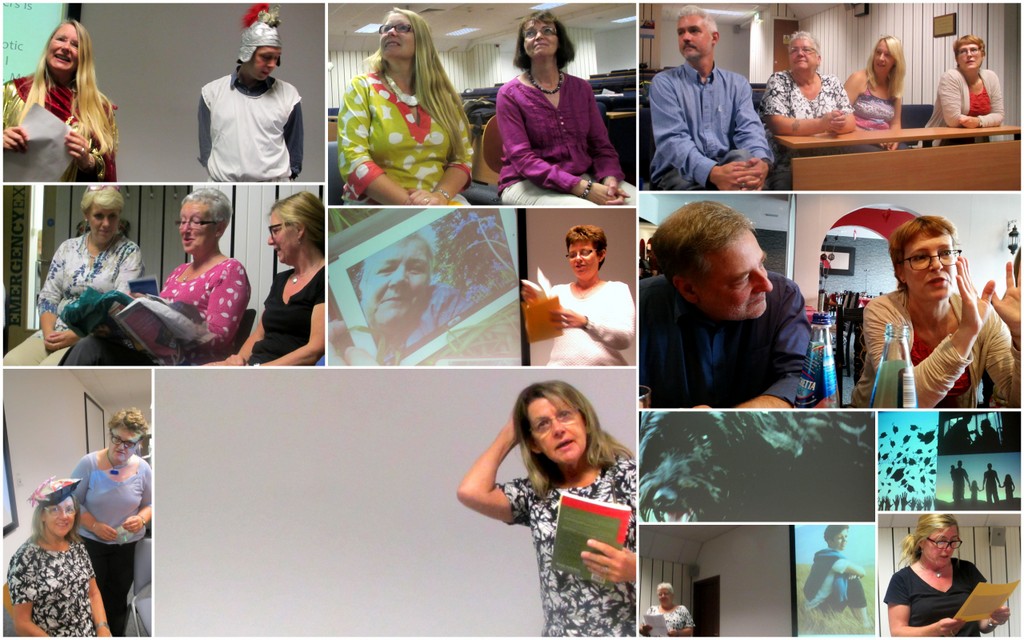
The newly formed ARTS in Research Collaborative recently held two days of exploration of biography and ways and means of expressing the stories of others creatively and ethically. The workshop was entitled, A Past/A Present” ARTS in Research (AiR) Workshop.

Using shared objects representing a time or event in each participant’s life, a ‘partner’ then created a five minute presentation of and from the storied materials. Participants in the two-days of exploration came from HSC, the Media School and DEC. Both faculty and postgrad students took part.

The brief was kept simple and instruction to a minimum. Organiser Kip Jones shared examples from his own work of finding ways and means of responding creatively to detailed data as well as time and material constraints. Other than that, participants engaged in a learning process through participation itself and the sharing of their experiences.

  • “Thank you all for the incredible willingness to be inventive, creative and think/be  outside ‘the box’”.
  • “An illuminating two days of deep sharing. I was honoured to be there and look forward to more creative adventures together”.
  • “Inspiring. An artful and generative suspension of ‘normal’ activity”.
Telling stories

The ARTS in Research Collaborative’s next workshop is planned for November at The Lighthouse in Poole. Details to follow. It will be open to a wider audience and there will be a charge to attend.


“I can’t remember ever attending such an inspiring event ‘in house’”.

The newly formed ARTS in Research Collaborative recently held two days of exploration of biography and ways and means of expressing the stories of others creatively and ethically. The workshop was entitled, A Past/A Present” ARTS in Research (AiR) Workshop.
Using shared objects representing a time or event in each participant’s life, a ‘partner’ then created a five minute presentation of and from the storied materials. Participants in the two-days of exploration came from HSC, the Media School and DEC. Both faculty and postgrad students took part.
The brief was kept simple and instruction to a minimum. Organiser Kip Jones shared examples from his own work of finding ways and means of responding creatively to detailed data as well as time and material constraints. Other than that, participants engaged in a learning process through participation itself and the sharing of their experiences. The group has agreed to write up the encounter for a journal article.

  • “Thank you all for the incredible willingness to be inventive, creative and think/be  outside ‘the box’”.

  • “An illuminating two days of deep sharing. I was honoured to be there and look forward to more creative adventures together”.

  • “Inspiring. An artful and generative suspension of ‘normal’ activity”.

The ARTS in Research Collaborative’s next workshop is planned for November at The Lighthouse in Poole. Details to follow. It will be open to a wider audience and there will be a charge to attend, but BU faculty and students are encouraged to apply for training and/or development funding within their Schools.

ARTS in Research (AiR) still accepting new members!

- See more at: http://blogs.bournemouth.ac.uk/research/2014/09/07/arts-in-research-air-collaborative-two-days-of-creative-scholarship/#sthash.BZJnmzp9.dpuf

“I can’t remember ever attending such an inspiring event ‘in house’”.

The newly formed ARTS in Research Collaborative recently held two days of exploration of biography and ways and means of expressing the stories of others creatively and ethically. The workshop was entitled, A Past/A Present” ARTS in Research (AiR) Workshop.
Using shared objects representing a time or event in each participant’s life, a ‘partner’ then created a five minute presentation of and from the storied materials. Participants in the two-days of exploration came from HSC, the Media School and DEC. Both faculty and postgrad students took part.
The brief was kept simple and instruction to a minimum. Organiser Kip Jones shared examples from his own work of finding ways and means of responding creatively to detailed data as well as time and material constraints. Other than that, participants engaged in a learning process through participation itself and the sharing of their experiences. The group has agreed to write up the encounter for a journal article.

  • “Thank you all for the incredible willingness to be inventive, creative and think/be  outside ‘the box’”.

  • “An illuminating two days of deep sharing. I was honoured to be there and look forward to more creative adventures together”.

  • “Inspiring. An artful and generative suspension of ‘normal’ activity”.

The ARTS in Research Collaborative’s next workshop is planned for November at The Lighthouse in Poole. Details to follow. It will be open to a wider audience and there will be a charge to attend, but BU faculty and students are encouraged to apply for training and/or development funding within their Schools.

ARTS in Research (AiR) still accepting new members!


AiR Workshop: telling stories (click on photo to enlarge)
- See more at: http://blogs.bournemouth.ac.uk/research/2014/09/07/arts-in-research-air-collaborative-two-days-of-creative-scholarship/#sthash.BZJnmzp9.dpuf

“I can’t remember ever attending such an inspiring event ‘in house’”.

The newly formed ARTS in Research Collaborative recently held two days of exploration of biography and ways and means of expressing the stories of others creatively and ethically. The workshop was entitled, A Past/A Present” ARTS in Research (AiR) Workshop.
Using shared objects representing a time or event in each participant’s life, a ‘partner’ then created a five minute presentation of and from the storied materials. Participants in the two-days of exploration came from HSC, the Media School and DEC. Both faculty and postgrad students took part.
The brief was kept simple and instruction to a minimum. Organiser Kip Jones shared examples from his own work of finding ways and means of responding creatively to detailed data as well as time and material constraints. Other than that, participants engaged in a learning process through participation itself and the sharing of their experiences. The group has agreed to write up the encounter for a journal article.

  • “Thank you all for the incredible willingness to be inventive, creative and think/be  outside ‘the box’”.

  • “An illuminating two days of deep sharing. I was honoured to be there and look forward to more creative adventures together”.

  • “Inspiring. An artful and generative suspension of ‘normal’ activity”.

The ARTS in Research Collaborative’s next workshop is planned for November at The Lighthouse in Poole. Details to follow. It will be open to a wider audience and there will be a charge to attend, but BU faculty and students are encouraged to apply for training and/or development funding within their Schools.

ARTS in Research (AiR) still accepting new members!


AiR Workshop: telling stories (click on photo to enlarge)
- See more at: http://blogs.bournemouth.ac.uk/research/2014/09/07/arts-in-research-air-collaborative-two-days-of-creative-scholarship/#sthash.BZJnmzp9.dpuf

“I can’t remember ever attending such an inspiring event ‘in house’”.

The newly formed ARTS in Research Collaborative recently held two days of exploration of biography and ways and means of expressing the stories of others creatively and ethically. The workshop was entitled, A Past/A Present” ARTS in Research (AiR) Workshop.
Using shared objects representing a time or event in each participant’s life, a ‘partner’ then created a five minute presentation of and from the storied materials. Participants in the two-days of exploration came from HSC, the Media School and DEC. Both faculty and postgrad students took part.
The brief was kept simple and instruction to a minimum. Organiser Kip Jones shared examples from his own work of finding ways and means of responding creatively to detailed data as well as time and material constraints. Other than that, participants engaged in a learning process through participation itself and the sharing of their experiences. The group has agreed to write up the encounter for a journal article.

  • “Thank you all for the incredible willingness to be inventive, creative and think/be  outside ‘the box’”.

  • “An illuminating two days of deep sharing. I was honoured to be there and look forward to more creative adventures together”.

  • “Inspiring. An artful and generative suspension of ‘normal’ activity”.

The ARTS in Research Collaborative’s next workshop is planned for November at The Lighthouse in Poole. Details to follow. It will be open to a wider audience and there will be a charge to attend, but BU faculty and students are encouraged to apply for training and/or development funding within their Schools.

ARTS in Research (AiR) still accepting new members!


AiR Workshop: telling stories (click on photo to enlarge)
- See more at: http://blogs.bournemouth.ac.uk/research/2014/09/07/arts-in-research-air-collaborative-two-days-of-creative-scholarship/#sthash.BZJnmzp9.dpuf

“I can’t remember ever attending such an inspiring event ‘in house’”.

The newly formed ARTS in Research Collaborative recently held two days of exploration of biography and ways and means of expressing the stories of others creatively and ethically. The workshop was entitled, A Past/A Present” ARTS in Research (AiR) Workshop.
Using shared objects representing a time or event in each participant’s life, a ‘partner’ then created a five minute presentation of and from the storied materials. Participants in the two-days of exploration came from HSC, the Media School and DEC. Both faculty and postgrad students took part.
The brief was kept simple and instruction to a minimum. Organiser Kip Jones shared examples from his own work of finding ways and means of responding creatively to detailed data as well as time and material constraints. Other than that, participants engaged in a learning process through participation itself and the sharing of their experiences. The group has agreed to write up the encounter for a journal article.

  • “Thank you all for the incredible willingness to be inventive, creative and think/be  outside ‘the box’”.

  • “An illuminating two days of deep sharing. I was honoured to be there and look forward to more creative adventures together”.

  • “Inspiring. An artful and generative suspension of ‘normal’ activity”.

The ARTS in Research Collaborative’s next workshop is planned for November at The Lighthouse in Poole. Details to follow. It will be open to a wider audience and there will be a charge to attend, but BU faculty and students are encouraged to apply for training and/or development funding within their Schools.

ARTS in Research (AiR) still accepting new members!


AiR Workshop: telling stories (click on photo to enlarge)
- See more at: http://blogs.bournemouth.ac.uk/research/2014/09/07/arts-in-research-air-collaborative-two-days-of-creative-scholarship/#sthash.BZJnmzp9.dpuf